ProjectManager vs Tempo: Strategic portfolio management comparison
A side-by-side look at ProjectManager and Tempo for teams weighing a standalone PM suite against Jira-native portfolio governance.


Key Takeaways
ProjectManager is a standalone project management suite built to be the system of record for execution across industries.
Tempo is a modular alternative to ProjectManager, designed to govern portfolios on top of Jira rather than replace it.
Tempo covers portfolio hierarchy, CapEx/OpEx financials, capacity planning, and AI-powered time tracking through Atlassian Rovo agents.
The decision usually comes down to one question: Do you want a new system of record for work, or governance on top of the Jira delivery data you already have?
ProjectManager pitches itself as a broad project and work management suite that fits construction, manufacturing, professional services, and IT. Its appeal is breadth. You get Gantt, kanban, sheets, and dashboards in one place, sold on a "fraction of the cost" story against enterprise incumbents.
Tempo goes the other direction. Instead of asking Atlassian-standardized teams to adopt a second system of record, Tempo treats Jira as the source of truth and adds portfolio structure, financial management, capacity planning, and AI-powered time tracking on top. If Jira already runs engineering, IT, and increasingly business teams, Tempo offers a modular alternative to ProjectManager – portfolio governance without moving execution to a new tool.
This page compares the two at a functional level so PMO, finance, and delivery leaders can see where each fits.
How do ProjectManager and Tempo compare?
ProjectManager is a standalone project and work management platform. Teams plan in Gantt, track in kanban or sheet views, and roll status into dashboards inside ProjectManager's own environment. Its Jira capability is described at the task level – viewing and updating ProjectManager tasks inside Jira – not as portfolio governance on top of Jira data.
Tempo offers a Jira-native strategic portfolio management (SPM) suite and serves more than 30,000 companies, with 15+ years in the Atlassian ecosystem. Its modules – including Tempo Structure PPM, Timesheets, Capacity Planner, Financial Manager, and Custom Charts – share Jira as their backbone. Portfolio hierarchies, capacity plans, and financial reports all reflect real delivery data without re-entry.
Tempo's products govern portfolios on top of Jira – adding CapEx/OpEx financial management, capacity planning, and cross-project hierarchy – without asking teams to migrate off the tool where delivery already runs. ProjectManager takes the opposite approach: it owns the plan inside its own environment, which means execution data lives in a separate system from Jira.
What each solution is best for
Best fit for | Tempo | ProjectManager |
|---|---|---|
Portfolio governance on Jira | Core design goal | Not the primary use case |
Cross-industry PM suite | Focused on Jira-connected orgs | Broad vertical coverage (construction, manufacturing, IT) |
CapEx/OpEx and labor cost governance | Built into Timesheets and Financial Manager | Labor-cost tracking via task rates, timesheets, and budget dashboards; no CapEx/OpEx classification or capitalization governance |
Fast onboarding for non-Jira teams | Requires Jira | Emphasized in ProjectManager's pitch |
PMO reporting on live delivery data | Native through Structure PPM and Custom Charts | Dashboards on ProjectManager-owned data |
Foundational differences between Tempo and ProjectManager
Dimension | Tempo | ProjectManager |
|---|---|---|
Primary purpose | Jira-native SPM – time, capacity, financial, and portfolio governance | Standalone project and work management suite across industries |
Portfolio management | Custom issue hierarchies across projects and programs | Project and portfolio views inside ProjectManager |
Financial management | Budget vs. actuals, labor costs, CapEx/OpEx, revenue and cost forecasting, and project and portfolio profitability | Not a stated CapEx/OpEx capability |
Capacity planning | Individual and team dashboards, availability-based planning across holidays and PTO, roles and generic resources, utilization, planned vs. actual | Workload and availability views inside ProjectManager |
Time tracking | AI-powered (Rovo agents), with approvals and CapEx/OpEx accounts | Time tracking as part of the suite |
Primary buyer | PMO, finance, Portfolio Managers, Engineering leadership | Project managers and operations leaders across verticals |
Jira integration | Native – Jira is the system of record | Integration – task-level sync, not native governance |
Read the table as a shape, not a scorecard. If Jira is already the execution system for most of your delivery work, a standalone suite adds a parallel source of truth – and reconciliation cost comes along with it.
How Tempo and ProjectManager approach AI and integrations
Tempo's AI runs through Atlassian Rovo agents tied to products. Timesheets Worklog Assistant handles natural-language time logging from Jira activity. Timesheets Summary Analyzer gives project and team leads a read on time allocation, and Time Insights for Jira surfaces user-level summaries.
Structure View Builder turns plain-English prompts into Structure configurations, Structure Formula Assistant helps build the formulas behind those views, and Custom Charts Assistant builds charts on Jira dashboards.
Every Timesheets suggestion needs human approval before it posts to a CapEx or OpEx account, and entries stay auditable line by line. Because every agent reads the same Jira issues Structure PPM, Capacity Planner, and Financial Manager govern, what the AI produces stays tied to the portfolio of record.
ProjectManager's public positioning leans on breadth of integrations and multi-view planning more than specific AI agents. Its Jira integration is described as task-level sync.
For Atlassian-standardized organizations, the integration question is usually the deciding one. Do you want execution data flowing out of Jira into another tool, or reporting and governance flowing on top of Jira? Teams already work in Jira. The choice is whether portfolio visibility follows the work or duplicates it.
Top ProjectManager strengths
ProjectManager has earned its footprint as a standalone PM suite.
Broad vertical coverage across construction, manufacturing, IT, and professional services.
"Fraction of the cost" narrative against heavier enterprise PM suites.
Fast onboarding for teams without an existing Atlassian footprint.
SOC 2 compliance to meet baseline enterprise security requirements.
What is Tempo's strength vs ProjectManager?
Tempo isn't another plan-of-record. It governs the Jira delivery data you already have, and that choice shapes how the modules are built.
Jira-native by design – Tempo doesn't ask teams to move execution to a new tool.
Portfolio governance through Structure PPM in the Tempo SPM suite, with custom hierarchies across projects and programs.
Financial depth: Financial Manager and Timesheets support CapEx/OpEx, labor costs, budget vs. actuals, revenue and cost forecasting, and project and portfolio profitability.
AI grounded in Jira reality – Rovo agents (Timesheets Worklog Assistant, Structure View Builder, Custom Charts Assistant, and more) work on the same issues that drive portfolio and capacity views.
Enterprise trust signals: SOC 1, SOC 2 Type 2, ISO 27001/27701, and PCI DSS certifications, plus CSA STAR Level 1, DORA alignment, and a VPAT, with GDPR and CCPA covered via standard DPA, with Fortune 500 customers. (Rovo and these certifications apply to Tempo Cloud; Tempo Data Center has a separate compliance posture.)
BI connectors – Power BI Connector for Jira, Power BI Connector for ServiceNow, Power BI Connector for monday.com, Tableau Connector for Jira, BigQuery Connector for Jira, Looker and Looker Studio support, plus SQL or data warehouse exports – ship as separate Marketplace apps from Tempo. They're separate modules within the Tempo SPM suite.
Rexel drives global team alignment with Tempo Structure PPM – a Jira-native enterprise deployment that spans regions and entities. Customers at that scale tend to need hierarchy, financial governance, and capacity depth built into the Atlassian fabric, not running alongside it in a separate system.
Ideal customer for each tool
Tempo is built for:
Enterprise PMO and EPMO groups governing portfolios on top of Jira.
Finance and FP&A teams that need CapEx/OpEx and labor cost governance tied to real delivery.
Engineering and product leaders running capacity planning against live Jira work.
Atlassian-standardized organizations that want to avoid a second system of record.
ProjectManager is built for:
Project managers who want a single standalone suite across Gantt, kanban, and sheets.
Cross-industry teams in construction, manufacturing, or IT looking for one PM platform.
Organizations without a deep Jira footprint that want a self-contained plan-of-record.
Teams prioritizing fast onboarding and lower price points over Jira-native governance.
When should you choose Tempo vs. ProjectManager?
Choose ProjectManager when… | Choose Tempo when… |
|---|---|
Jira isn't your delivery system of record | Jira is already your delivery system of record |
You want a standalone PM suite across industries | You want portfolio governance on top of Jira |
Budget pressure favors a lower-priced suite | Governance, financial, and capacity depth matter more than price alone |
Task-level Jira sync is enough | You need Jira-native SPM with CapEx/OpEx and AI-powered time tracking |
Recap
The decision usually comes down to one question: is Jira already where your delivery teams work? If it is, Tempo's suite adds portfolio governance, financial depth, and capacity planning on top of data that already exists – no migration, no reconciliation. If it isn't, ProjectManager offers a self-contained plan-of-record with broad vertical coverage. Start with your execution system. The tool choice follows.
Sign up for a demo
Request DemoIf your organization is Atlassian-standardized and your PMO, finance, and engineering leaders are asking for portfolio-level visibility tied to the work teams log, Tempo offers the modular alternative to ProjectManager – portfolio governance, financial depth, and capacity planning on top of Jira, without a parallel system of record.
Compare Tempo to other solutions
See Comparisons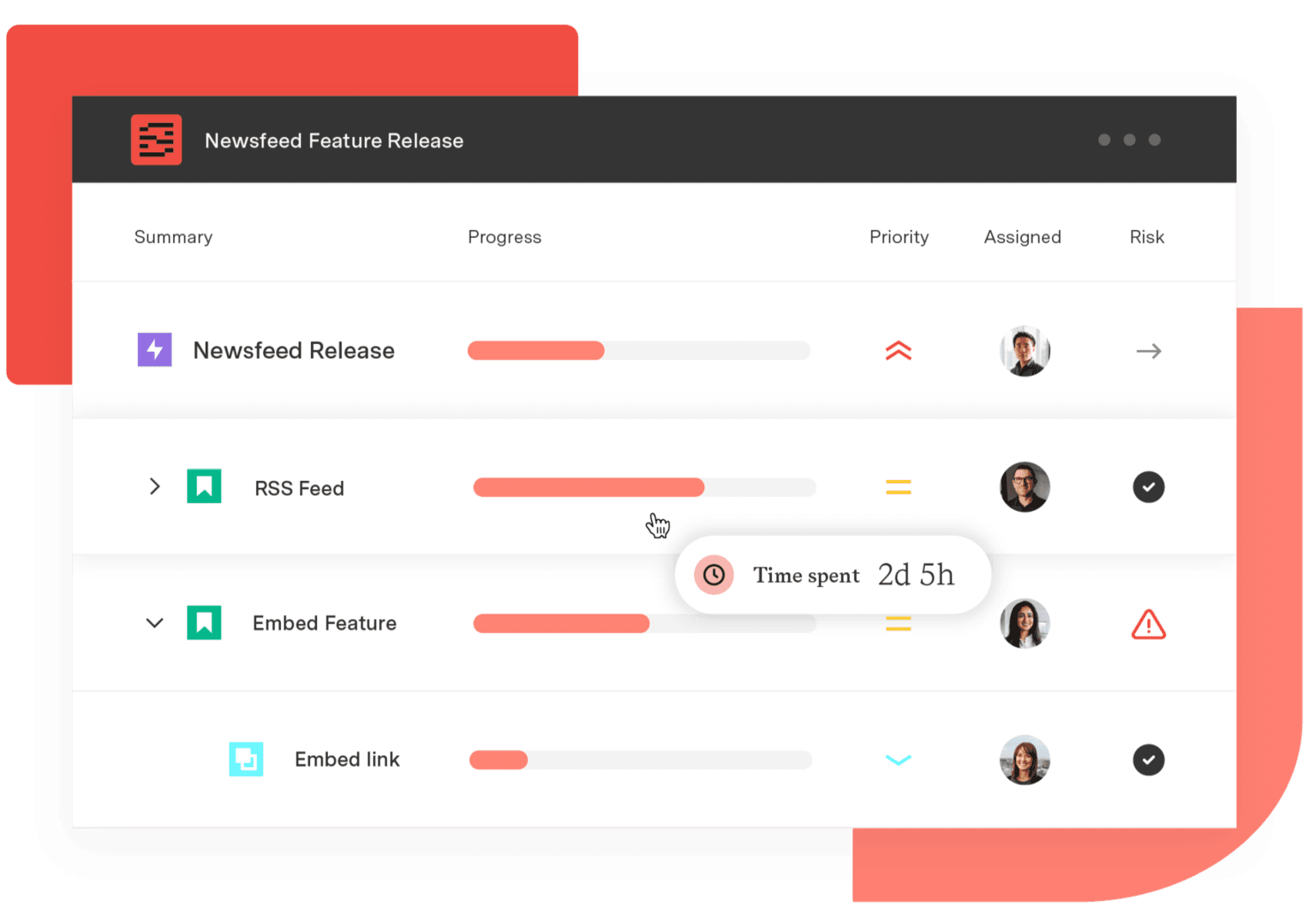
Structure PPM
Align your entire organization
Manage products, projects, and programs in a single spreadsheet-like view. By providing a clear, real-time view of project progress and resource allocation, Structure helps teams meet deadlines and adapt swiftly to changing priorities.
Start a Free TrialFrequently Asked Questions
Couldn't find what you need?Go to our documentation
ProjectManager offers a Jira integration at the task level – viewing and updating ProjectManager tasks inside Jira. Tempo takes a different approach: Jira is the system of record, and Tempo modules read and write against it natively.
Yes. Tempo Timesheets and Tempo Financial Manager support CapEx/OpEx accounts, labor cost tracking, and budget vs. actuals reporting.
Tempo's named Atlassian Rovo agents include the Timesheets Worklog Assistant (natural-language time logging from Jira activity), Timesheets Summary Analyzer (time-allocation read for project and team leads), Time Insights for Jira (user-level summaries), Structure View Builder (natural-language Structure config), Structure Formula Assistant (formula building), and Custom Charts Assistant (charts on Jira dashboards). Every Timesheets suggestion needs human approval before it posts to a CapEx or OpEx account, and entries stay auditable line by line. Rovo is available across paid Atlassian Cloud plans, with full credit allocations on Premium and Enterprise.
Tempo maintains SOC 1, SOC 2 Type 2, ISO 27001/27701, and PCI DSS certifications, plus CSA STAR Level 1, DORA alignment, and a VPAT, with GDPR and CCPA covered via standard DPA. These apply to Tempo Cloud; Tempo Data Center has a separate compliance posture.
Not at portfolio scale tied to Jira. ProjectManager covers Gantt, kanban, sheets, dashboards, and time tracking inside its own platform, but its public positioning doesn't include CapEx/OpEx labor classification or capacity governance tied to a Jira system of record. Tempo Financial Manager and Tempo Capacity Planner cover those capabilities natively against Jira data.
Not as a native Marketplace app. ProjectManager has a Jira integration at the task level rather than a Marketplace-listed Jira-native app. Tempo's SPM suite is on the Atlassian Marketplace with 15+ years of deployment, and Tempo is an Atlassian Partner of the Year three years running.
ProjectManager publishes per-user tier pricing positioned as a "fraction of the cost" against heavier enterprise PM suites. Tempo's pricing is published per product on the Atlassian Marketplace, with tiered per-user pricing for each module. The more useful comparison isn't unit license cost: it's total cost of governance. ProjectManager pricing covers a standalone PM suite. Tempo pricing covers Jira-native portfolio, financial, and capacity governance on top of the delivery system you already run. Buyers should pull live quotes from both vendors at their seat count.