monday.com vs. Tempo: Portfolio management comparison
Tempo governs portfolios with delivery truth from Jira – monday.com is a horizontal work platform without Jira-native financial or capacity controls.


Key Takeaways
Tempo runs inside Jira as the system of record; monday.com is a standalone work platform connected via integration
monday.com is strong as a horizontal AI work platform; Tempo is built for Jira-native portfolio governance and economics
Tempo provides CapEx/OpEx tracking and Jira-grounded labor cost actuals that monday.com doesn't offer natively
PMO and finance teams need auditable time-to-cost traceability inside Jira, not a second work system on top of it
monday.com holds a strong position across multiple work management categories. Tempo, available on the Atlassian Marketplace, is a modular alternative for organizations that want portfolio governance grounded in Jira delivery truth rather than added alongside a second work system.
Tempo and monday.com aren't always rivals. Tempo's BI Connector for monday.com shows how the tools can work together. Both have broad reach: monday.com cites 60% of the Fortune 500, and Tempo works with one in three.
monday.com positions as having "solutions for every team." The Tempo SPM suite (strategic portfolio management) keeps delivery truth in Jira – budget vs. actuals, labor cost, and capacity constraints wired directly to Jira worklog data.
How do monday.com and Tempo compare?
Tempo offers a Jira-native strategic portfolio management suite and serves 30,000+ companies. Its modular product line – including Structure PPM, Timesheets, Capacity Planner, Financial Manager, and Custom Charts – extends Jira's data model directly.
monday.com is a work platform built to support many teams across many functions with configurable boards, automations, and AI agents. Per monday.com's published positioning, it's a horizontal "work OS" with solution pages for marketing, operations, product, IT, and general project work. It offers a Jira connector for teams that run engineering in Jira and want cross-functional visibility in monday.com.
The two products go after overlapping portfolio buyers from different starting points. Tempo assumes Jira is already the system of record for execution – the unmet need is portfolio governance with financial controls and capacity mechanics, not a second work surface. monday.com assumes teams want a horizontal platform with no-code configurability and AI agents spanning many functions.
What each solution is best for
Tempo | monday.com |
|---|---|
Jira-native portfolio governance with financial and capacity controls | Horizontal AI work platform spanning many team types |
CapEx/OpEx tracking, labor cost actuals, and project profitability | No-code configurability with boards, automations, and AI agents |
Individual and team capacity planning with planned vs. actual reporting | Broad departmental solution pages covering multiple functions |
AI-assisted time tracking via Rovo agents (paid Atlassian Cloud; full credits on Premium and Enterprise), with human approval before CapEx/OpEx posting and line-by-line audit | Agentic AI story with cross-team workflow automation |
Foundational differences between Tempo and monday.com
Dimension | Tempo | monday.com |
|---|---|---|
Primary purpose | Jira-native SPM – time, capacity, financial, and portfolio governance | Horizontal AI work platform for every team |
Portfolio management | Custom issue hierarchies across projects and programs | Portfolio views built from boards and items within monday.com |
Financial management | Budget vs. actuals, labor costs, CapEx/OpEx, expenses – plus revenue and cost forecasting and project profitability | Budget tracking via columns and dashboards across boards; not built for ledger-grade CapEx/OpEx accounting against Jira worklog data |
Capacity planning | Individual + team dashboards, planned vs. actual | Workload views based on tasks within monday.com |
Time tracking | AI-assisted via Rovo agents, with human approval before entries hit CapEx/OpEx accounts and line-by-line audit trail | Native time-tracking column in monday.com Work Management; not built for CapEx/OpEx classification tied directly to Jira issues |
Primary buyer | PMO, finance, Portfolio Managers, Engineering leadership | Cross-functional operations leaders, department heads, program managers |
Jira integration | Native – Jira is the system of record | Integration – connector; positioned as a cross-team work platform alongside Jira |
Across these dimensions, the two products address different problems. monday.com covers horizontal work across many team types; Tempo governs delivery economics inside Jira with domain-specific financial and capacity mechanics. They're not trying to solve the same thing.
If delivery runs on Jira and the unmet need is CapEx/OpEx discipline and capacity reality, adding monday.com as a second surface doesn't fix the governance problem. Tempo addresses it directly.
How Tempo and monday.com approach AI and integrations
Tempo's Rovo agents span the full Jira suite. On the Structure PPM side, Structure View Builder configures portfolio views from a plain-language prompt and Structure Formula Assistant writes the rollup formulas. On the Timesheets side, Timesheets Worklog Assistant handles natural-language time logging in Jira, Timesheets Summary Analyzer gives project and team leads a read on where hours are going, and Time Insights for Jira covers user-level summaries against native Jira worklogs.
A human approves every entry before it hits a CapEx/OpEx account, and every entry is auditable line by line. The AI makes time and cost data more accurate, and that data flows into financial actuals and capacity reporting. It extends Jira's data model directly and works on the same data that drives delivery.
Tempo Custom Charts adds a Custom Charts Assistant that builds Jira dashboard charts from natural-language prompts.
Integrations follow the same logic. Power BI Connector for Jira, Tableau Connector for Jira, BigQuery Connector for Jira, the Looker connector, plus Oracle Analytics and SAP Analytics Cloud connectors are separate Tempo Marketplace apps that push Jira execution data into the enterprise BI tools where finance, PMO, and exec dashboards already live. The portfolio signal lands where the decisions get made, not inside another cross-team work platform.
Tempo and monday.com aren't strictly head-to-head. The decision splits on Jira. If the team is on Jira, Tempo is the direct replacement for portfolio operations, and monday.com's cross-tool reconciliation overhead tips most buyers toward Tempo.
Keeping a separate work platform in sync with Jira adds cross-tool configuration and reconciliation work that grows with every new board, automation, and integration.
If the team isn't on Jira (or runs monday.com mostly as a CRM or business-team work surface), Tempo plus Power BI Connector for monday.com is the complement path. Keep monday.com where it earns its place, add Tempo's Jira-native portfolio governance on top, and consolidate reporting in Power BI.
Either way, Tempo's Power BI Connector ecosystem reads monday.com data, and Tempo Custom Charts can surface monday.com workflows on Jira dashboards. Replace or complement – the architecture handles both.
monday.com's AI posture is agentic and horizontal. Its AI agents are positioned to automate cross-functional workflows, surface insights across boards, and cut operational overhead for many team types. Combined with no-code configurability and a broad library of solution pages, monday.com is built to apply AI across many functions rather than to a specific domain like portfolio economics.
The philosophies split at a basic point: monday.com solves for horizontal coverage across functions; Tempo solves for portfolio economics inside a single Jira-native system of record. Both use AI – but pointed at different problems.
Top monday.com strengths
monday.com has built a serious horizontal work platform – analyst recognition, Fortune 500 reach, and an agentic AI story that lands across many team types. For cross-functional work coverage, there's real substance behind the positioning.
Highly configurable no-code Work OS spanning many team types, with agentic AI agents, Workload capacity views, and a large app and template ecosystem
Agentic AI story with AI agents embedded across cross-functional workflows
No-code configurability that lets non-technical teams build and adapt boards quickly
What is Tempo's strength vs monday.com?
Tempo treats portfolio work as a Jira-native governance problem with financial and capacity mechanics – not a horizontal coverage problem. The AI, the data, and the system of record all stay inside Jira. TransUnion, for example, reduced workflow approvals from 17 levels to four with Tempo Timesheets – the kind of governance impact that comes from running the numbers inside Jira rather than on top of a separate work platform. More examples are on the Tempo customer stories page.
Jira-native architecture that extends Jira's data model directly, with Jira as the system of record
Financial governance – CapEx/OpEx, labor cost actuals, budget vs. actuals, revenue and cost forecasting, and project and portfolio profitability – that monday.com's scope doesn't substantiate
Individual and team capacity planning based on real availability – hours, holidays, PTO, and existing commitments, with roles and utilization – and planned vs. actual reporting grounded in Jira delivery data
Domain-specific AI via Atlassian Rovo agents for time tracking, variance detection, workload insights, custom formulas, and dashboard chart building, with human approval before CapEx/OpEx posting and line-by-line audit
Concrete adoption path: Start with Tempo Timesheets or Structure – this covers time tracking and portfolio visibility on day one
Add Tempo Financial Manager when finance asks for CapEx reporting; add Capacity Planner when planning conversations need real numbers, not headcount estimates
Ideal customer for each tool
Tempo is the right fit when:
PMO and finance need auditable cost actuals tied to Jira delivery data
Capacity planning is required at the individual and team level across engineering and product
Jira is the system of record and portfolio governance has to stay inside it
Delivery-to-cost traceability and CapEx/OpEx classification are required deliverables
monday.com is the right fit when:
The primary challenge is horizontal work coverage across many department types
No-code configurability and agentic AI across functions align with the organization's strategy
Cross-functional coordination outside of engineering is the main unmet need
Jira is acceptable as a connected tool rather than the authoritative portfolio surface
When should you choose Tempo vs. monday.com?
Choose Tempo | Choose monday.com |
|---|---|
Finance and PMO need cost actuals and CapEx/OpEx classification on Jira data | Horizontal work coverage across many team types is the primary need |
Capacity planning is required at the team and individual level | No-code configurability and agentic AI drive the purchase |
Jira must remain the single system of record with no parallel application | A cross-team work platform is preferred across non-engineering functions |
Project profitability and budget vs. actuals are required deliverables | Departmental solution pages and broad use cases carry weight |
Recap
monday.com is a real option for cross-functional teams that aren't anchored to Jira. No-code configurability, agentic AI across departments, and broad solution coverage – the platform earns its analyst recognition.
When Jira is already the system of record, the governance gap is specific: how capacity gets planned against real availability, how labor cost converts into CapEx/OpEx, how budget ties back to delivery milestones.
Sign up for a demo
Request DemoAdding another work system on top of Jira doesn't close that gap. Tempo closes it with CapEx/OpEx classification, capacity dashboards, and financial actuals running natively on Jira worklog data.
The clearest way to choose: if the problem is horizontal work coverage, monday.com is the right primary surface. If the problem is delivery-to-cost traceability on Jira, start with Tempo Timesheets or Structure and add Financial Manager when finance needs the CapEx numbers.
Compare Tempo to other solutions
See Comparisons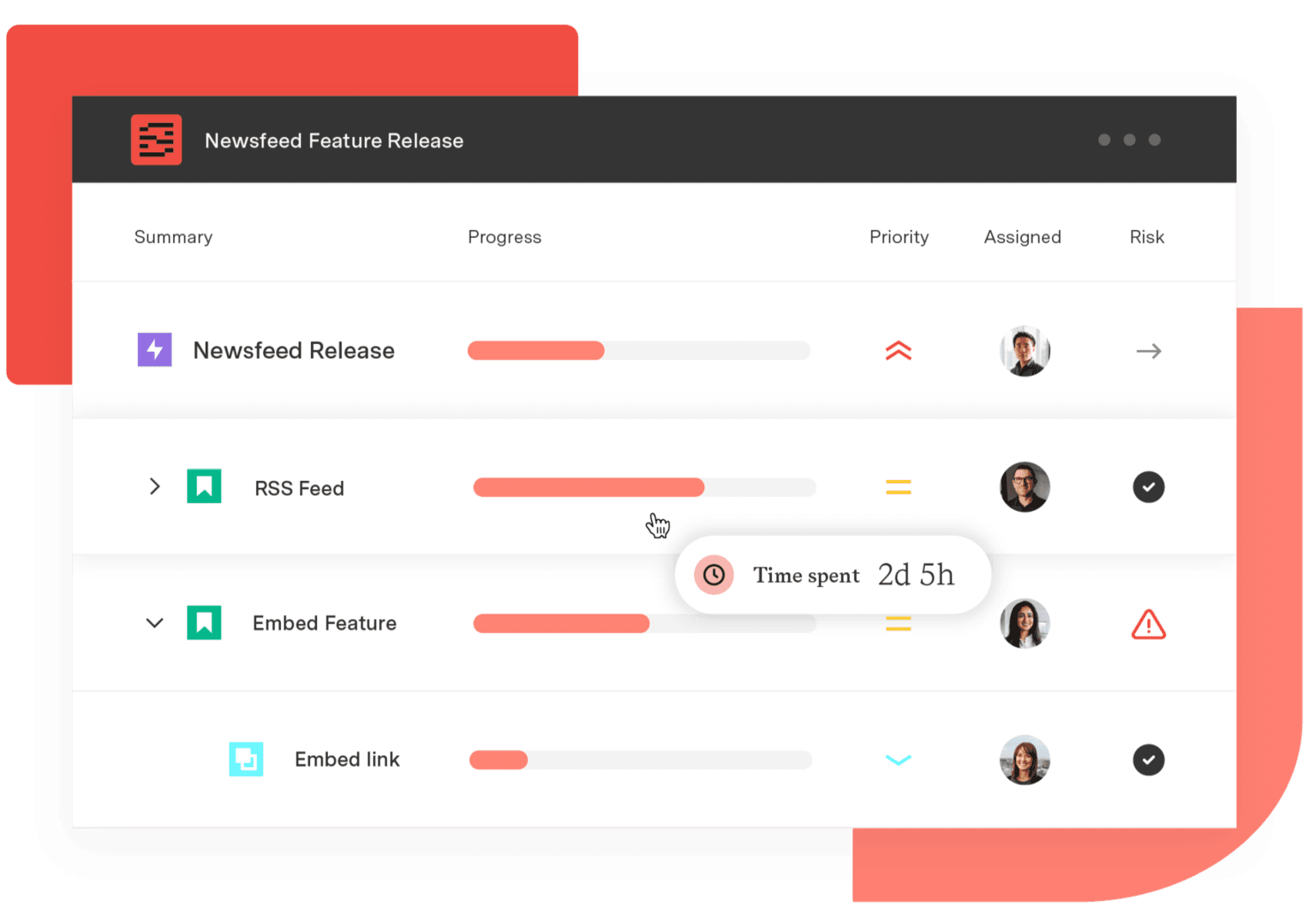
Structure PPM
Align your entire organization
Manage products, projects, and programs in a single spreadsheet-like view. By providing a clear, real-time view of project progress and resource allocation, Structure helps teams meet deadlines and adapt swiftly to changing priorities.
Start a Free TrialFrequently Asked Questions
Couldn't find what you need?Go to our documentation
Yes. Organizations often use monday.com for horizontal work coverage across many departments while using Tempo inside Jira for engineering and product portfolio governance, capacity planning, and financial control. Because Tempo runs inside Jira, it doesn't compete with monday.com's cross-functional scope.
Tempo Financial Manager and Tempo Timesheets provide CapEx/OpEx classification, labor cost actuals, budget vs. actuals, and project profitability tied to Jira delivery data. monday.com offers time tracking and budget columns but doesn't substantiate CapEx/OpEx mechanics or auditable financial actuals at Tempo's depth, based on public product positioning.
Tempo Timesheets uses named Atlassian Rovo agents – the Timesheets Worklog Assistant, the Timesheets Summary Analyzer, and Time Insights for Jira – available across paid Atlassian Cloud plans (full credits on Premium and Enterprise). They handle time-logging suggestions, variance detection, and workload insights grounded in Jira data. A human approves every entry before it hits a CapEx/OpEx account, and every entry is auditable line by line. monday.com's AI agents are positioned as horizontal workflow automation across many team types. The two approaches reflect distinct jobs – domain-specific portfolio accuracy for Tempo, horizontal work productivity for monday.com.
For organizations moving engineering and product portfolio governance from monday.com to Tempo, the work is mostly about activating Tempo modules inside Jira rather than migrating data between applications. Because Tempo reads Jira natively, delivery data is already in place. Financial configuration and capacity setup happen inside Tempo.
Not at Tempo's depth. monday.com offers a time tracking column, Workload views for capacity, and budget columns, but it doesn't provide CapEx/OpEx classification, labor cost actuals, project profitability reporting, or capacity planning grounded in live Jira delivery data. Those capabilities sit in Tempo Timesheets, Tempo Capacity Planner, and Tempo Financial Manager respectively, all running natively inside Jira.
Not as a native Marketplace app. monday.com offers a Jira connector that syncs items between the two systems and is positioned as a cross-team work platform alongside Jira rather than inside it. Tempo, by contrast, is sold and installed through the Atlassian Marketplace and runs inside Jira itself.
Both vendors price on a per-user basis with tiered plans, but the buying motion is different. Tempo is sold as modular Marketplace apps that can be activated independently. monday.com is sold as a unified work platform with feature-tier pricing and minimum seat counts on higher tiers. For current numbers, check monday.com's pricing page and Tempo's Atlassian Marketplace listings directly.