Businessmap vs. Tempo: Portfolio governance and OKR execution comparison
Compare Businessmap's outcome and OKR alignment platform with Tempo's Jira-native portfolio governance, financial controls, and capacity planning.


Key Takeaways
Businessmap (formerly Kanbanize) is built around outcome and OKR alignment. Tempo is built around portfolio execution governance with financial and capacity depth.
Businessmap talks to Jira as an integration. Tempo is Jira-native, with Jira as the system of record.
Tempo leads with CapEx/OpEx, labor cost, and budget vs. actuals. Businessmap doesn't show equivalent financial governance on-page.
Strategy and Ops leaders can use Businessmap for OKR storytelling and Tempo for tying outcomes to Jira delivery, capacity, and cost.
Businessmap (formerly Kanbanize) and Tempo both speak to transformation-oriented buyers – Strategy and Ops leaders, transformation managers, PMO, and finance – but from different centers of gravity. Businessmap's positioning leads with outcomes, OKRs, and Flight Levels methodology. Tempo offers a modular alternative for teams that want strategy tied to auditable execution data inside Jira.
Outcome alignment only matters when it connects to work that has a budget, a team, and a delivery timeline. Businessmap builds that alignment story on its own boards. Tempo ties it to the Jira issues, budgets, and capacity plans where delivery happens.
Tempo runs natively on the Atlassian Marketplace with Fortune 500 deployments. This page helps strategy, PMO, and finance buyers figure out where each tool fits.
How do Businessmap and Tempo compare?
Businessmap positions around "Deliver outcomes, not just tasks" with an OKR and KPI alignment story and the Flight Levels methodology as its core intellectual anchor. Its ICP includes transformation leadership and its community includes agile coaches. Jira shows up as an integration.
Tempo offers a Jira-native SPM suite. Tempo Structure PPM provides custom issue hierarchies across projects and programs. Tempo Financial Manager covers budget vs. actuals, labor costs, and CapEx/OpEx. Tempo Capacity Planner offers individual and team dashboards with planned vs. actual. Tempo Timesheets delivers AI-powered time tracking through Atlassian Rovo agents.
Both tools address the portfolio question, but from opposite directions. Businessmap leads with outcomes and OKR alignment, using Flight Levels methodology as its anchor. Tempo starts with the Jira data – whether planned work has budget, people, and a realistic delivery date – and builds governance from there.
For enterprises standardized on Jira, Businessmap adds a separate platform for outcome alignment. Tempo keeps that governance inside Jira, on the same issues and worklogs as the work itself.
What each solution is best for
Use case | Best fit |
|---|---|
OKR and KPI alignment with outcome storytelling | Businessmap |
Jira-native portfolio governance and reporting | Tempo |
Financial controls: CapEx/OpEx, labor cost, budget vs. actuals | Tempo |
Flight Levels methodology and transformation facilitation | Businessmap |
AI-powered time tracking through Rovo agents | Tempo |
Foundational differences between Tempo and Businessmap
Dimension | Tempo | Businessmap |
|---|---|---|
Primary purpose | Jira-native SPM – time, capacity, financial, and portfolio governance | Outcome and OKR alignment platform with Flight Levels methodology |
Portfolio management | Custom issue hierarchies across projects and programs | Outcome-oriented portfolio boards and OKR alignment |
Financial management | Budget vs. actuals, labor costs, CapEx/OpEx, expenses – plus revenue and cost forecasting and project and portfolio profitability | Outcomes-focused metrics and value-delivery analytics across the portfolio; not built for ledger-grade CapEx/OpEx accounting |
Capacity planning | Individual and team dashboards, planned vs. actual | WIP limits, workload tracking, and Timeline-based team planning; not tied to live Jira delivery or planned vs. actual at the worklog level |
Time tracking | AI-powered (Rovo agents), with approvals and CapEx/OpEx accounts | Native time logging against cards and subtasks with worklog reports; no CapEx/OpEx account classification tied to Jira worklogs |
Primary buyer | PMO, finance, Portfolio Managers, Engineering leadership | Strategy and Ops leaders, transformation managers, PMO/Finance |
Jira integration | Native – Jira is the system of record | Connector, not native |
Businessmap's "Save MILLIONS" value claim sits on top of an alignment and flow narrative. Tempo grounds portfolio value in financial governance and capacity realism against real Jira artifacts. The two can coexist – but the financial controls and Jira-native reporting belong in Tempo, not in a separate alignment layer.
How Tempo and Businessmap approach AI and integrations
Tempo's Rovo agents run across the suite inside Jira. Structure View Builder configures portfolio views from natural-language prompts; Structure Formula Assistant builds the formulas behind rollups; Custom Charts Assistant generates Jira dashboard charts on demand. On the Timesheets side, Timesheets Worklog Assistant, Timesheets Summary Analyzer, and Time Insights for Jira cover time logging, allocation reads, and user-level summaries. A human approves before any entry posts to a CapEx or OpEx account, and every entry is auditable line by line. The agents read the same issues, worklogs, and sprints teams already work in – no separate data layer.
Businessmap's integration story includes Jira among its connectors. Its community of agile coaches and Flight Levels practitioners supports the methodology itself.
Businessmap has its own AI – a built-in assistant, AI Planning, AI-powered whiteboards and analytics, and native MCP support for connecting external AI tools like Claude. For Jira-standardized enterprises, the difference comes down to what the AI reads. Tempo's Rovo signals run on the Jira issues, worklogs, and sprints that are the delivery system of record. Businessmap's AI runs on its own boards, a step removed from that delivery data.
Top Businessmap strengths
Businessmap occupies a specific corner of the market around outcomes, OKRs, and Flight Levels methodology, backed by a community of transformation leaders and agile coaches.
Outcome-first messaging – "Deliver outcomes, not just tasks."
Flight Levels methodology as a strategy-to-delivery anchor.
Transformation leadership ICP and agile coach community.
OKR and KPI alignment story with visible methodology artifacts.
Heritage as Kanbanize, with depth in flow-based thinking.
Flow metrics and cycle-time analytics for measuring and improving delivery flow
What is Tempo's strength vs Businessmap?
Tempo picks up where outcome storytelling ends. Strategy connects to the work that has cost, capacity, and a delivery date in Jira – governance on the delivery artifacts themselves, not on a parallel platform.
Sky Betting & Gaming is one published example – the team uses Tempo Custom Charts to consolidate Jira reporting that previously lived across spreadsheets and one-off boards. Businessmap's outcomes don't reach that far down: They don't touch the underlying Jira data the reports run on.
Strategy tied to financial outcomes – CapEx/OpEx, labor cost, budget vs. actuals, revenue and cost forecasting, and project and portfolio profitability.
Jira-native portfolio governance through custom issue hierarchies in Tempo Structure PPM.
Capacity realism via individual and team dashboards with planned vs. actual.
AI time and workload insights through Atlassian Rovo agents – Timesheets Worklog Assistant, Timesheets Summary Analyzer, and Time Insights for Jira (Rovo runs on paid Atlassian Cloud plans; full credit allocations on Premium and Enterprise).
Auditable controls on the delivery system of record rather than a separate alignment platform.
Ideal customer for each tool
Choose Tempo if:
Jira is the system of record for engineering delivery.
Strategy outcomes need to be tied to cost, capacity, and delivery artifacts.
PMO and finance need auditable governance their stakeholders can trust, beyond alignment storytelling.
You want AI time and capacity insights through Rovo agents like Timesheets Worklog Assistant and Timesheets Summary Analyzer (available on paid Atlassian Cloud plans; full credits on Premium and Enterprise).
Choose Businessmap if:
Your center of gravity is OKR alignment and outcome storytelling, run by transformation leaders.
Flight Levels methodology is a strategic anchor for your organization.
Your primary buyer is a transformation leader, not PMO or finance.
You're willing to run outcome alignment on a separate platform from your delivery system.
When should you choose Tempo vs. Businessmap?
Criterion | Choose Businessmap | Choose Tempo |
|---|---|---|
Primary job | OKR alignment and outcome narrative | Portfolio execution governance |
Methodology anchor | Flight Levels | Jira-native hierarchies |
Financial governance | No native CapEx/OpEx financial governance | Core capability |
Delivery backbone | Integration-connected | Jira as system of record |
Recap
Businessmap owns the outcomes and OKR alignment layer, with Flight Levels methodology as its anchor. If your portfolio question goes further – into CapEx/OpEx accounting, capacity realism, and auditable delivery governance on Jira data – that's where Tempo picks up. Start with the use-case table above to see which gaps you're trying to close.
Sign up for a demo
Request DemoFor strategy, PMO, and finance leaders in Jira-standardized enterprises, Tempo keeps governance on the same Jira issues and worklogs as the work, and adds AI through Rovo agents.
Compare Tempo to other solutions
See Comparisons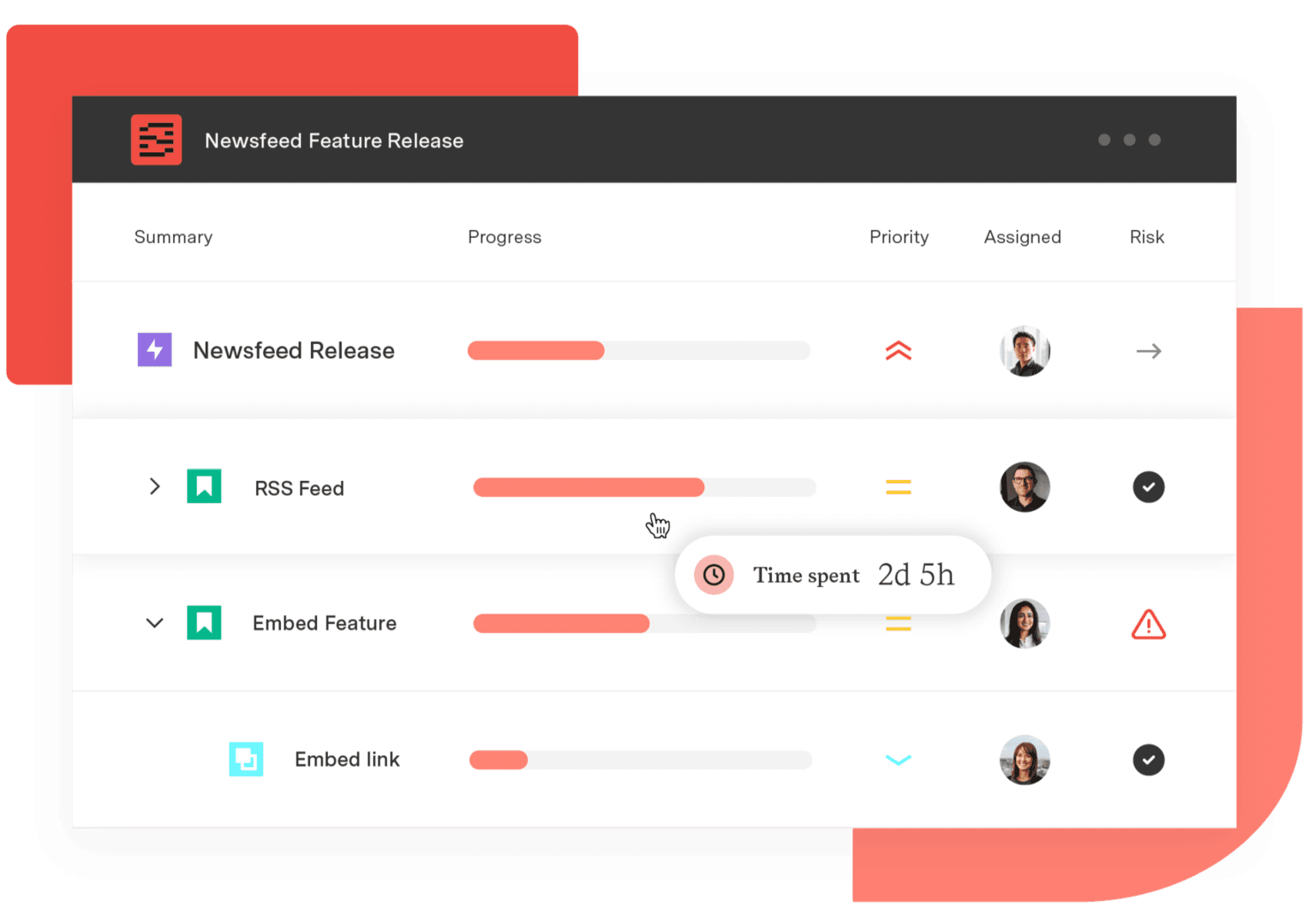
Structure PPM
Align your entire organization
Manage products, projects, and programs in a single spreadsheet-like view. By providing a clear, real-time view of project progress and resource allocation, Structure helps teams meet deadlines and adapt swiftly to changing priorities.
Start a Free TrialFrequently Asked Questions
Couldn't find what you need?Go to our documentation
Businessmap offers native time logging – against cards and subtasks, with worklog categories and reports – plus capacity tools like WIP limits, workload tracking, and Timeline-based team planning, alongside its outcome-alignment and Flight Levels focus. What it doesn't provide is CapEx/OpEx account classification tied to Jira worklogs; that sits in Tempo Timesheets, Tempo Capacity Planner, and Tempo Financial Manager.
Businessmap offers a Jira integration, but it is a connector, not a Jira-native app. Tempo runs natively on the Atlassian Marketplace.
Both vendors publish current pricing on their own websites and quote based on user count and modules. Compare current Tempo pricing at tempo.io and Businessmap pricing on businessmap.io rather than relying on third-party numbers.
Tempo Structure PPM provides custom issue hierarchies that link portfolio and program work to Jira delivery artifacts. Tempo Financial Manager and Tempo Capacity Planner tie outcomes to cost and capacity.
Tempo Timesheets uses Atlassian Rovo agents – the Timesheets Worklog Assistant for natural-language time logging in Jira, the Timesheets Summary Analyzer for project and team-lead insights, and Time Insights for Jira for user-level time summaries – for AI-powered time logging suggestions, variance detection, and workload insights. Beyond Timesheets, Rovo agents span the suite: Structure View Builder turns a plain-language prompt into a portfolio view, Structure Formula Assistant writes rollup formulas, and Custom Charts Assistant builds Jira dashboard charts from natural-language prompts. Rovo is available across paid Atlassian Cloud plans, with full credit allocations on Premium and Enterprise.
Strategy and Ops leaders, transformation managers, and PMO/Finance teams in Jira-standardized enterprises who want alignment plus execution governance.
Tempo serves 30,000+ companies with 15+ years in the Atlassian ecosystem and is a three-time Atlassian Partner of the Year. Tempo Structure PPM scales to 30,000 issues per structure on Cloud and roughly 100,000 on Data Center, with support for multi-instance Jira and audit-ready governance. Compliance includes SOC 1, SOC 2 Type 2, ISO 27001/27701, and PCI DSS certifications, plus CSA STAR Level 1, DORA alignment, and a VPAT, with GDPR and CCPA covered via standard DPA. Rovo agents and these certifications apply to Tempo Cloud; Data Center has a separate compliance posture.