Appfire vs. Tempo: Strategic portfolio management comparison
Appfire bundles Jira apps under one EULA with BigPicture for visual planning. Tempo adds compliance-first ledger governance to Jira.


Key Takeaways
Tempo has a Jira-native portfolio management suite built around financial governance, capacity planning, and operational accountability.
Appfire bundles Jira and Confluence apps under one commercial agreement. Its PPM entry is BigPicture, which includes a Financials Module for budget baselines and labor cost rollups.
Tempo ties time tracking, capacity planning, and financial management into a single portfolio economics stack pulled from Jira work data.
If PMO and finance teams need CapEx/OpEx tracking, planned vs. actual reporting, and audit-ready governance, Tempo is built for those outcomes.
Teams shopping for a modular alternative to Appfire tend to weigh two things: apps and productivity, or portfolio economics. Appfire's value sits on the first – enterprise app consolidation, one EULA, and cloud migration support. Tempo sits on the second, turning the Jira work record into financial and operational truth that PMOs and CFOs can defend.
Both companies have been on the Atlassian Marketplace for years, and both are good at what they do. The difference is the job they're hired for. Admins and program managers rationalizing an app stack get more from Appfire. PMO directors and controllers who need CapEx/OpEx accuracy, capacity variance, and portfolio rollups tied to actual Jira work get more from Tempo.
This page compares Tempo vs Appfire on primary purpose, financial depth, capacity planning, time tracking, and Jira integration. It's written to help PMO leaders, finance controllers, and product leadership make a fair call.
How do Appfire and Tempo compare?
Appfire is an Atlassian technology partner that sells a portfolio of Jira and Confluence apps under a single commercial agreement – the "one EULA" model. The apps cover project reporting, workflow automation, diagramming, collaboration, and project portfolio management. Appfire's PPM offering is anchored by BigPicture, a visual program and portfolio management app that brings Gantt-based planning and dependency tracking to Jira data, with resource visualization layered on top.
Tempo has a Jira-native strategic portfolio management (SPM) suite and serves 30,000+ companies. The suite – including Structure PPM in the SPM suite, Timesheets, Capacity Planner, Financial Manager, and Custom Charts – gives finance teams, PMO leaders, and engineering leadership a full operational and financial view of work, pulled straight from Jira.
Both products live inside the Atlassian ecosystem; they serve different jobs. Appfire focuses on ecosystem productivity – pulling disparate Jira apps under one commercial agreement, simplifying licensing, and pushing what Jira can display. Tempo's products focus on portfolio economics, turning Jira work into a governed financial and operational record.
What each solution is best for
Use case | Tempo | Appfire |
|---|---|---|
PMO/Finance governance | Compliance-first – automated CapEx/OpEx ledgering, GL-mapped accounts, line-by-line audit | BigPicture Financials Module – budget baselines, hourly rates, labor cost from Jira logs |
Visual program planning | Gantt Charts for Structure PPM supports program views | BigPicture is a strong fit for Gantt-based visual planning |
Atlassian app consolidation | Tempo has a focused suite | Strong fit – one EULA across 200+ Jira and Confluence apps |
Time tracking with financial rollup | Tempo Timesheets with CapEx/OpEx account types, approvals, and Rovo agents | BigPicture pulls hours from Jira logs into program-level cost rollups |
Cloud migration adjacency | Tempo supports enterprise Cloud migrations | Appfire is widely known as a Cloud migration partner |
Foundational differences between Tempo and Appfire
Dimension | Tempo | Appfire |
|---|---|---|
Primary purpose | Jira-native SPM – time, capacity, financial, and portfolio governance | Atlassian Marketplace app portfolio under a single commercial agreement; BigPicture anchors PPM |
Portfolio management | Custom issue hierarchies across projects and programs via Structure PPM | BigPicture provides program boxes, visual hierarchy, and Gantt planning on Jira data |
Financial management | Compliance-first ledger architecture: CapEx/OpEx account types, GL-mapped approvals, line-by-line audit, plus revenue and cost forecasting and project and portfolio profitability | BigPicture Financials Module: Budget baselines, configurable hourly rates, labor cost from Jira logs, time-phased estimated vs. actual, hierarchical cost rollups |
Capacity planning | Individual + team dashboards, planned vs. actual, skills-based assignment | Resource load visualization within BigPicture; not centered on PvA |
Time tracking | Suggested entries via Atlassian Rovo agents (paid Atlassian Cloud; full credits on Premium and Enterprise), with human approvals and CapEx/OpEx accounts | BigPicture reads logged hours from Jira; CapEx/OpEx classification is not its native focus |
Primary buyer | PMO, finance, Portfolio Managers, Engineering leadership | Jira administrators, program managers, teams consolidating Atlassian apps |
Jira integration | Native extension – directly extends Jira's financial data model with Account objects, cost rates, and approval flows | Native visualization – builds custom hierarchies and views (BigPicture Boxes, Gantt rollups) on top of Jira's existing data model |
When a PMO director or CFO asks "Are we spending in the right places?" or "What did this program cost compared to what we budgeted?", the answer requires time actuals, capacity data, account classifications, and financial rollups tied to the same Jira issues engineers update every day. That's the job Tempo's products are built for.
Appfire's catalog, with BigPicture at the center, answers a different need: visual program planning and administrative consolidation of the Atlassian app stack.
How Tempo and Appfire approach AI and integrations
Tempo's Rovo agents span the whole suite inside Jira, not just timesheets. Structure View Builder turns plain-language prompts into Structure portfolio views and Structure Formula Assistant writes the rollup formulas, while Custom Charts Assistant builds charts on Jira dashboards. On the time side, Tempo Timesheets works with three agents on paid Atlassian Cloud plans: Timesheets Worklog Assistant logs time in Jira from natural-language prompts, Timesheets Summary Analyzer gives project and team leads a read on where hours are going, and Time Insights for Jira covers user-level summaries.
Both suggest entries from Jira activity, flag variance between planned and logged hours, and surface workload patterns. Each suggestion runs through Tempo's standard approval flow before it lands against a CapEx or OpEx account code, and every entry is auditable line by line. The human approver owns the timesheet that goes to finance, not the agent. Tempo Cloud carries SOC 1, SOC 2 Type 2, ISO 27001/27701, and PCI DSS certifications, plus CSA STAR Level 1, DORA alignment, and a VPAT; GDPR and CCPA are covered via standard DPA. Data Center deployments operate under their own compliance posture.
Appfire has formalized AI across its catalog under the Appfire AI initiative, running on Microsoft Azure infrastructure. Agile Poker uses AI to analyze dependencies and suggest effort estimations. Appfire Flow is marketed to engineering leaders for tracking how AI code assistants affect cycle times. Appfire's AI surface sits inside its own product line, with Microsoft as the infrastructure substrate.
The gap is backend infrastructure rather than UI surface – both deliver insights inside Jira. Tempo's Rovo agents run on Atlassian's native Rovo intelligence, governed by Atlassian's permissions model and tied to the same approval flows that send time entries to finance.
Appfire's app-level AI – Agile Poker's effort estimations, Live Fields text corrections, and the broader Appfire AI initiative – is embedded directly in Jira via each app and processes tasks securely on Appfire's enterprise Azure OpenAI substrate. Both are real AI integrations. They differ on what fabric powers them.
The integration philosophies split at the handoff between delivery and financial governance. Tempo assumes those two concerns belong in the same system – an engineer's timesheet entry informs the program's cost variance report without an intermediate export. Appfire's catalog approach is additive: Each app adds a capability, and customers build the stack they need from the Marketplace.
Top Appfire strengths
Appfire is well-known on the Atlassian Marketplace, and its strengths cluster around commercial consolidation and visual program planning – the areas buyers most often single it out for.
Enterprise trust under the "one EULA" model, pulling many Atlassian apps under one commercial agreement
BigPicture as a mature visual PPM app for program and portfolio planning in Jira, with a dedicated Financials Module for budget baselines, hourly rates, and labor cost rollups
Appfire AI initiative on Microsoft Azure infrastructure – Agile Poker for AI-assisted effort estimation and dependency analysis, Appfire Flow for tracking AI code assistant impact on engineering cycle times
Breadth of catalog across reporting, workflow automation, diagramming, and collaboration apps
What is Tempo's strength vs Appfire?
Appfire and Tempo both have financials inside Jira. The distinction is depth and posture. Appfire's BigPicture Financials Module handles program-level budgets, hourly rates, and cost rollups. Tempo Financial Manager is built for compliance-first finance workflows – audit-grade accounting that sits beneath program management, where capitalization and GL mapping happen.
Tempo's CapEx/OpEx ledger is automated and account-typed. Timesheets writes entries against four account types (Capitalized, Operational, Billable, Internal) with GL-mapped approvals, so capitalized hours land in the right ledger without manual reclassification. Financial Manager builds on that ledger with revenue and cost forecasting and project and portfolio profitability.
Tempo's audit trail is line-by-line. Every worklog – including Rovo-suggested entries – passes through a human approval before it touches a financial account, and the trail is preserved at the entry level for the auditor.
Tempo's AI lives inside Jira's native UI. Timesheets works with Atlassian Rovo agents – Worklog Assistant, Summary Analyzer, and Time Insights for Jira – governed by Atlassian's permissions model and tied to Tempo's approval flow.
Tempo is modular. Start with Structure or Timesheets. Add Financial Manager when finance asks for CapEx reporting. Add Capacity Planner when planning conversations need real numbers.
Tempo maintains SOC 1, SOC 2 Type 2, ISO 27001/27701, and PCI DSS certifications, plus CSA STAR Level 1, DORA alignment, and a VPAT, with GDPR and CCPA covered via standard DPA for enterprise procurement.
Tempo is priced per product on the Atlassian Marketplace; Appfire’s catalog is offered under a bundled commercial structure. Tempo sells each product directly, so the spend matches what’s deployed.
Tempo runs at enterprise scale today. TransUnion replaced a legacy time-tracking system with Tempo Timesheets, consolidating portfolio governance and approval workflows.
Ideal customer for each tool
Choose Tempo if:
Your PMO or finance team measures success by cost variance, portfolio ROI, or CapEx/OpEx allocation accuracy
You need a governed record of who worked on what, for how long, and at what cost – with approvals and audit trails
Your engineering or product org runs on Jira and you want capacity planning and financial reporting without a second system
You're scaling a multi-team, multi-program delivery organization and need a hierarchy that goes beyond Jira's native structure
Choose Appfire if:
Your main driver is simplifying your Atlassian app licensing and reducing vendor relationships
BigPicture's visual program planning and Gantt capabilities are the core PPM requirement
You value a partner with breadth across reporting, workflow, diagramming, and collaboration apps
Jira Cloud migration support from an experienced Atlassian partner is a near-term priority
When should you choose Tempo vs. Appfire?
Choose Tempo | Choose Appfire |
|---|---|
Finance and PMO need real-time labor cost tracking, CapEx/OpEx classification, and budget vs. actuals | Visual Gantt and dependency planning in Jira is the primary portfolio management requirement |
Planned vs. actual reporting must come from Jira worklogs without manual export | App catalog consolidation under one EULA is a material procurement priority |
Capacity planning requires individual and team-level dashboards and skills-based assignment | The team is mid-Atlassian Cloud migration and needs ecosystem-wide app support from one partner |
Strict financial compliance and CapEx/OpEx audit trails are procurement priorities | The organization wants specialized apps for diagramming, retrospectives, or workflow automation alongside PPM |
Recap
Appfire and Tempo both live inside the Atlassian ecosystem, and both serve teams running delivery in Jira. They solve different problems. Appfire's offer is ecosystem consolidation and visual planning – the right fit for teams rationalizing a fragmented app portfolio or leaning on BigPicture's program view. If that's the requirement, Appfire handles it well.
Tempo's offer is portfolio economics. It answers what CFOs, controllers, and PMO directors ask when they have to justify program investment, defend CapEx classifications, or figure out whether actual capacity matched what was planned.
Sign up for a demo
Request DemoThose answers have to come from the same source as delivery – and for Tempo's customer base, that source is Jira. Tempo's products make Jira where the financial record lives, not just where the work gets tracked.
Compare Tempo to other solutions
See Comparisons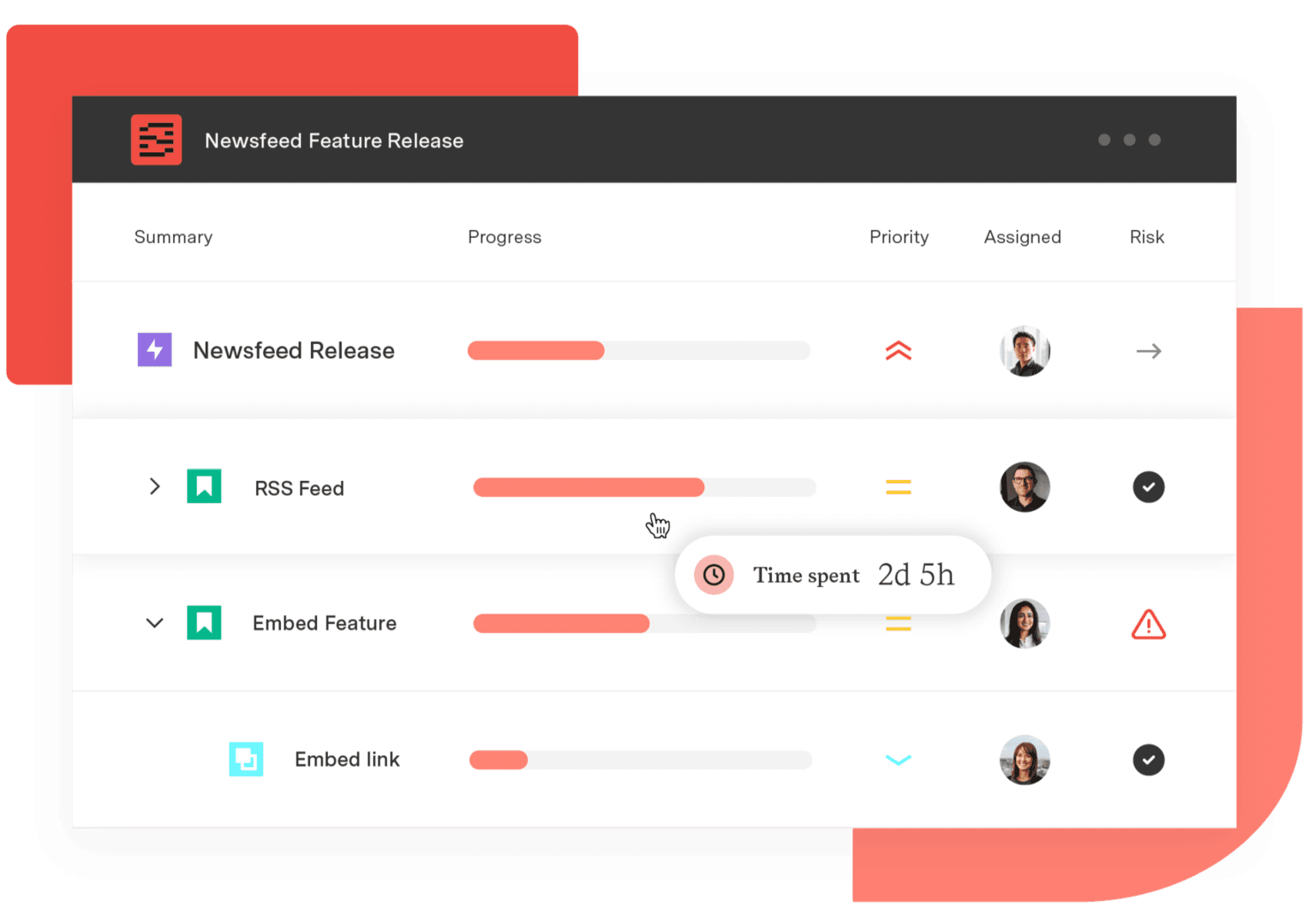
Structure PPM
Align your entire organization
Manage products, projects, and programs in a single spreadsheet-like view. By providing a clear, real-time view of project progress and resource allocation, Structure helps teams meet deadlines and adapt swiftly to changing priorities.
Start a Free TrialFrequently Asked Questions
Couldn't find what you need?Go to our documentation
Tempo Timesheets and Tempo Structure PPM are available on Jira Cloud and Data Center. If you're mid-migration from Data Center to Cloud, Tempo supports that transition since the suite runs on the same Atlassian platform. Appfire and Tempo both distribute through the Atlassian Marketplace.
Tempo is modular. You can start with Tempo Timesheets for time tracking and CapEx/OpEx classification, then add Tempo Capacity Planner, Tempo Financial Manager, and Tempo Structure PPM as needs grow. Each product enriches the others when used together.
Tempo maintains SOC 1, SOC 2 Type 2, ISO 27001/27701, and PCI DSS certifications, plus CSA STAR Level 1, DORA alignment, and a VPAT, with GDPR and CCPA covered via standard DPA. Buyers should verify current certification documentation from both vendors during procurement.
Yes, through BigPicture's Financials Module. It handles budget baselines, configurable hourly rates, labor cost calculations from Jira logs, time-phased estimated vs. actual cost comparisons, and hierarchical cost rollups from tasks up to the portfolio level. The distinction with Tempo isn't presence or absence – it's posture. Tempo Financial Manager is built for compliance-first workflows: Automated CapEx/OpEx ledgering, GL-mapped account types, and a line-by-line audit trail. Both are real financial layers. They answer different questions for different buyers.
BigPicture reads logged hours from Jira and uses them for program-level cost rollups. Native CapEx/OpEx classification with account-type taxonomy and GL-mapped approvals is Tempo Timesheets' specific layer – four account types (Capitalized, Operational, Billable, Internal), human approvals before entries land against accounts, and a line-by-line audit trail. Atlassian Rovo agents on paid Atlassian Cloud plans – Worklog Assistant, Summary Analyzer, and Time Insights for Jira – suggest entries from Jira activity for the human approver to confirm.
Tempo's pricing is per-product and tier-based on the Atlassian Marketplace. Appfire's pricing is also published on the Atlassian Marketplace, but bundled across its app catalog under a single commercial agreement. The more useful comparison isn't unit cost: it's what each spend buys. Appfire spend buys breadth across the Atlassian app stack. Tempo spend buys financial and portfolio governance from Jira worklogs.