airfocus vs Tempo: Portfolio governance vs product strategy comparison
Tempo governs portfolios with financial and capacity controls built on Jira data – airfocus is a product strategy workspace that sits alongside Jira.


Key Takeaways
Tempo extends Jira's data model directly, with no parallel system of record
airfocus owns product strategy, roadmapping, and prioritization; Tempo owns financial governance, capacity, and delivery economics
Based on its product scope, airfocus isn't built for CapEx/OpEx tracking, time-to-cost conversion, or profitability mechanics – Tempo provides that layer
Product leaders, PMO, and finance teams needing portfolio governance, financial controls, and capacity tied to delivery data should know airfocus is built for a different job – product strategy and roadmapping
In the product management category, airfocus is a defensible choice – its prioritization frameworks, customizable hierarchies, OKR alignment, and polished roadmap views have earned strong traction with product teams. Tempo, available on the Atlassian Marketplace, is a modular alternative for organizations that want portfolio decisions powered by Jira execution data rather than a separate product workspace.
Where airfocus is built for product managers who need a dedicated space to think about strategy, the Tempo SPM suite is built for product leaders, PMO, finance, and delivery leaders who need financial governance and capacity controls grounded in the system of record – Jira itself.
airfocus has a solid Jira integration. What it doesn’t have is Jira data at the source – every portfolio view depends on a sync cycle catching up to what engineering logged.
How do airfocus and Tempo compare?
Tempo offers a Jira-native strategic portfolio management suite and serves 30,000+ companies. Its modular product line – including Structure PPM, Timesheets, Capacity Planner, Financial Manager, and Custom Charts – extends Jira's data model directly. No competing system of record.
airfocus (now part of Lucid, sometimes branded "airfocus by Lucid") is a product management platform built to help product teams build strategic roadmaps, prioritize initiatives using frameworks like "Value vs. Effort" scoring, and align product decisions to OKRs. It offers a Jira integration that pulls issues into airfocus for prioritization and roadmapping, positioning itself as a product workspace that sits alongside Jira rather than inside it.
The split is sharpest at the portfolio review: airfocus answers “what should we build next?” Tempo answers “what did it cost, did we have the capacity, and did it return what we expected?”
What each solution is best for
Tempo | airfocus |
|---|---|
Jira-native portfolio governance with financial and capacity controls | Product strategy workspace for roadmapping and prioritization |
CapEx/OpEx tracking, labor cost actuals, and project profitability | Value vs. Effort scoring and OKR-aligned prioritization |
Individual and team capacity planning with planned vs. actual reporting and live roadmapping | Customizable item hierarchies and roadmap views |
AI-assisted time tracking via Rovo agents (paid Atlassian Cloud; full credits on Premium and Enterprise), with human approval before CapEx/OpEx posting and line-by-line audit | Fast onboarding for product managers with under 30 days to value |
Foundational differences between Tempo and airfocus
Dimension | Tempo | airfocus |
|---|---|---|
Primary purpose | Jira-native SPM – time, capacity, financial, and portfolio governance | Product strategy workspace for roadmapping, prioritization, and OKR alignment |
Portfolio management | Custom issue hierarchies across projects and programs | Customizable item hierarchies within the airfocus workspace |
Financial management | Budget vs. actuals, labor costs, CapEx/OpEx, expenses – plus revenue and cost forecasting and project profitability | Strategy-driven prioritization frameworks for planning and prioritization; not built for ledger-grade financial accounting against delivery work |
Capacity planning | Individual + team dashboards, planned vs. actual at the Jira worklog level | High-level capacity mapping across quarters and releases (Enterprise tier); does not connect to Jira worklog data |
Time tracking | AI-assisted via Rovo agents (paid Atlassian Cloud; full credits on Premium and Enterprise), with human approval before entries hit CapEx/OpEx accounts and line-by-line audit trail | Light effort estimation and capacity scoring on roadmap items; not built for granular time entries against Jira work items |
Primary buyer | Product leaders, PMO, finance, Portfolio Managers, Engineering leadership | Product managers, product directors, CPOs |
Jira integration | Native – Jira is the system of record | Integration – strong Jira sync but creates a parallel system of record |
On product strategy dimensions, airfocus does its job well – roadmap views, OKR alignment, Enterprise-tier capacity mapping across quarters and releases. It doesn’t connect to individual-execution detail: Jira worklogs, time-to-cost classification, CapEx/OpEx reporting. Tempo is purpose-built for those dimensions and does the work inside Jira rather than alongside it.
External strategy workspaces – airfocus among them – rely on synced updates between the workspace and the delivery system. That sync model can introduce data coordination gaps: When engineering logs unplanned incident hours or scope changes directly in Jira, the strategy workspace depends on the next sync cycle to reflect them. Tempo eliminates that sync dependency.
Because Tempo Capacity Planner and Structure PPM extend Jira's data model directly, every committed initiative is tied to the Jira hours logged against it in real time. A product leader sees the slip before the next QBR.
How Tempo and airfocus approach AI and integrations
Tempo’s AI runs on Rovo agents across the whole suite. On the Structure PPM side, Structure View Builder configures portfolio views from a plain-language prompt and Structure Formula Assistant builds the formulas. Custom Charts Assistant turns natural-language prompts into Jira dashboard charts. Tempo Timesheets adds three more: Worklog Assistant for natural-language time logging, Summary Analyzer for project and team-lead time allocation, and Time Insights for Jira for user-level time summaries against native Jira worklogs. A human approves every entry before it hits a CapEx/OpEx account, and every entry is auditable line by line.
The job is narrow: Make time and cost data more reliable, so financial reporting and capacity views hold up. Tempo extends Jira's data model directly, so the AI works on the same delivery data that drives execution. (Rovo and Tempo's compliance certifications apply to Tempo Cloud; Data Center has a separate compliance posture.)
By contrast, airfocus applies AI to product strategy work – drafting roadmap content, surfacing prioritization suggestions, and refining OKR language. Those capabilities cut the cognitive overhead of product planning and can speed up roadmapping for product managers.
The split comes down to a single assumption: does the best strategic input live outside the delivery system, or inside it? airfocus bets on a dedicated thinking space. Tempo bets that execution data in Jira is already the most valuable input available – and that surfacing it for portfolio decisions beats building a parallel workspace on top of it.
Top airfocus strengths
airfocus's prioritization frameworks, roadmap views, and security posture hold up for product teams who want a dedicated strategy workspace.
Customizable hierarchies and roadmap views that adapt to how different product organizations think
Fast onboarding with a stated time-to-value of under 30 days for product strategy workflows, per airfocus's published security and onboarding positioning
Strong Jira integration that pulls issues into airfocus for prioritization and roadmapping
OKR alignment that connects initiatives to measurable outcomes
Security posture including ISO 27001 and SOC 2, with EU data hosting as an option, per airfocus's published security and onboarding positioning
What is Tempo's strength vs airfocus?
Tempo pulls the portfolio conversation out of a product strategy workspace and into Jira-native governance. That shift brings financial actuals, capacity, and cost discipline that airfocus doesn't carry. Case studies show how enterprises like Rexel drive global team alignment with Tempo Structure PPM across operating regions; more examples are on the Tempo customer stories page.
Financial governance – CapEx/OpEx tracking, labor cost actuals, revenue and cost forecasting, and project and portfolio profitability – that airfocus doesn't offer
Native Jira architecture that extends Jira's data model directly
Individual and team capacity planning with planned vs. actual reporting grounded in Jira data
AI-assisted time tracking via Atlassian Rovo agents, with human approval before CapEx/OpEx posting and line-by-line audit
OKR linkage that holds up against execution data: Tempo Structure PPM groups Jira work under custom hierarchies so OKR-aligned initiatives stay tied to the Jira issues being delivered, not the roadmap artifact that committed them
Concrete adoption path: Start with Timesheets or Structure. Add Financial Manager when finance asks for CapEx reporting. Add Capacity Planner when planning conversations need real numbers, not headcount estimates.
Ideal customer for each tool
Tempo is the right fit when:
Product leaders, PMO, and finance need auditable financial governance on top of Jira data
Capacity planning and resource allocation are required across teams and programs
Jira has to remain the single system of record with no parallel application
The buying decision involves the CPO, finance, PMO, or delivery ops leaders who need cost and capacity visibility
airfocus is the right fit when:
Product managers are the primary users and roadmapping is the core need
OKR alignment and product strategy communication are the problems to solve
Fast onboarding is a priority and a 30-day time-to-value matters more than financial governance
A standalone product strategy workspace is acceptable alongside Jira
When should you choose Tempo vs. airfocus?
Choose Tempo | Choose airfocus |
|---|---|
Product leaders, finance, and PMO are co-buyers who need cost actuals and CapEx/OpEx classification | Product managers are the primary buyers and roadmapping is the core need |
Portfolio governance must stay inside Jira as the single source of truth | A standalone product strategy workspace is acceptable alongside Jira |
Capacity planning is required at the team and individual level | Prioritization frameworks and OKR linkage are the primary value drivers |
Profitability and budget vs. actuals are required deliverables | Stakeholder roadmap communication is the primary output |
Recap
The dividing line isn’t quality – it’s scope. airfocus handles the product strategy conversation well. It reaches its limit when the CPO, finance, or PMO joins the portfolio review with capacity and cost questions those tools weren’t built to answer.
Tempo is built for the follow-on conversation: "What did it cost, did we have the capacity, and did it return what we expected?" Those questions need financial governance, time tracking, CapEx/OpEx mechanics, and capacity actuals tied to real delivery data. Tempo provides all of that natively inside Jira, without asking the organization to maintain a second system of record.
For organizations running Jira and looking to govern portfolios at scale – with product leaders, finance, and PMO in the room – the question isn’t which tool is better. It’s which conversation the organization is having first.
Sign up for a demo
Request DemoIf prioritization frameworks and OKR drafting are the core need, airfocus is the right call. If the conversation has shifted to financial governance, CapEx/OpEx accountability, and capacity actuals grounded in delivery data, start with Tempo Structure PPM and Timesheets – add Financial Manager and Capacity Planner when finance and PMO are in the room.
Compare Tempo to other solutions
See Comparisons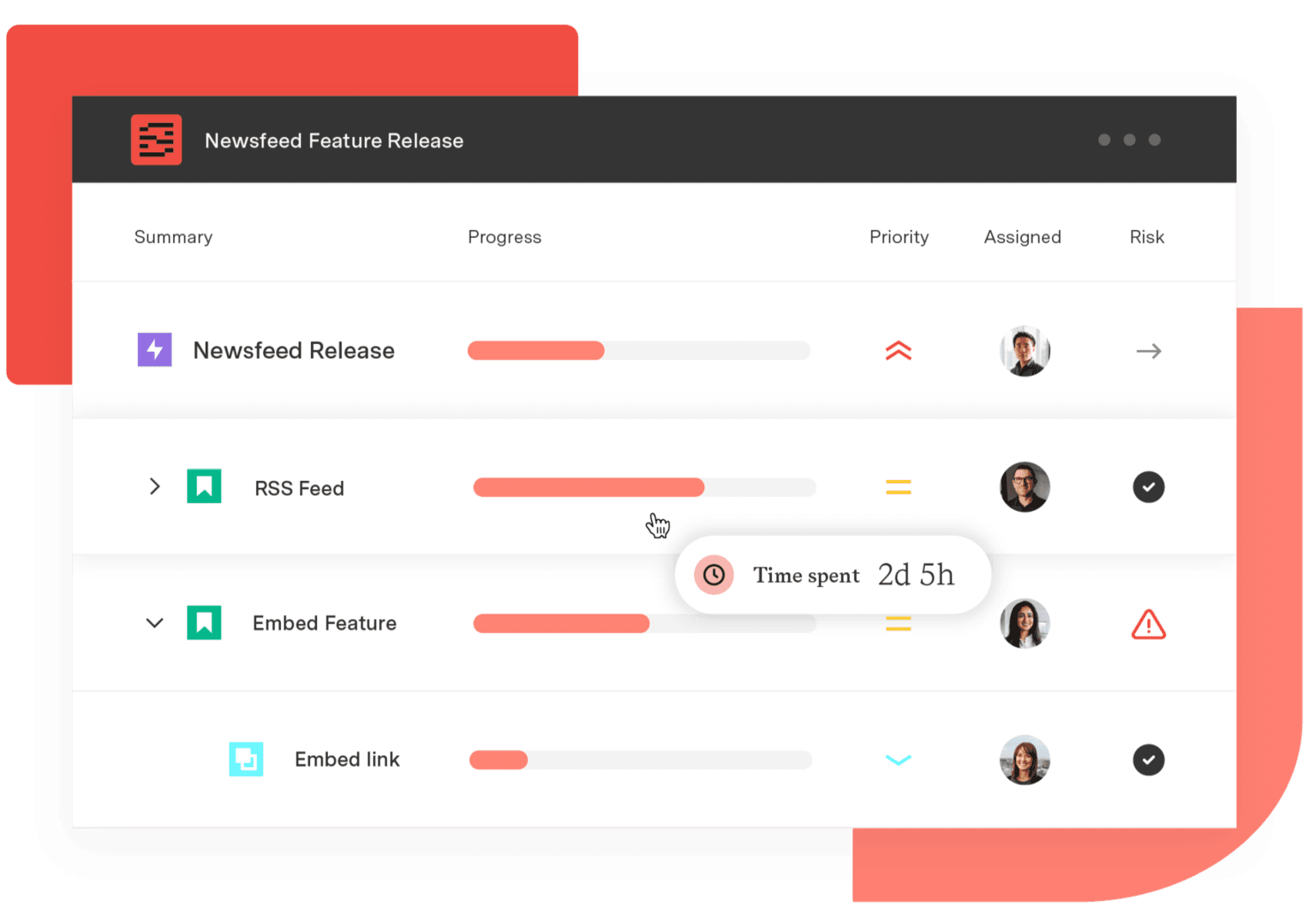
Structure PPM
Align your entire organization
Manage products, projects, and programs in a single spreadsheet-like view. By providing a clear, real-time view of project progress and resource allocation, Structure helps teams meet deadlines and adapt swiftly to changing priorities.
Start a Free TrialFrequently Asked Questions
Couldn't find what you need?Go to our documentation
Yes – for a while. Organizations use airfocus for product roadmapping and prioritization and Tempo for financial governance, time tracking, and capacity planning inside Jira. The two handle different layers of the portfolio conversation. Jira stays the system of record, with airfocus consuming it and Tempo reporting on it. Most enterprises eventually face a budget conversation: if one tool can cover both strategy artifacts and execution governance, Tempo's modular path is what the CFO usually approves.
Based on airfocus's stated product scope, it doesn't include CapEx/OpEx classification, time-to-cost conversion, or project profitability reporting. Tempo Financial Manager and Tempo Timesheets provide that layer, tied directly to Jira delivery data and team time logs.
For organizations moving portfolio governance from airfocus to Tempo, the work is mostly about activating Tempo modules in Jira rather than migrating data between applications. Because Tempo reads Jira natively, the delivery data that matters – issues, projects, hierarchies – is already there. Financial configuration and capacity setup happen inside Tempo.
Tempo Timesheets uses named Atlassian Rovo agents – the Timesheets Worklog Assistant, the Timesheets Summary Analyzer, and Time Insights for Jira – available across paid Atlassian Cloud plans (full credits on Premium and Enterprise). They handle time-logging suggestions, variance detection, and workload insights. A human approves every entry before it hits a CapEx/OpEx account, and every entry is auditable line by line. airfocus applies AI to the product strategy layer for roadmap and prioritization drafting. The two AI approaches reflect the products' distinct jobs – operational data accuracy for Tempo, strategic planning for airfocus.
airfocus includes high-level capacity mapping across quarters and releases on its Enterprise tier, but it doesn't include native time tracking, worklog-grounded capacity planning, or financial management with CapEx/OpEx mechanics. Those capabilities sit in Tempo Timesheets, Tempo Capacity Planner, and Tempo Financial Manager respectively, all running natively inside Jira.
airfocus offers a Jira integration but isn't a Jira-native Atlassian Marketplace app the way Tempo is – it operates as a separate workspace that syncs with Jira via API. Tempo, by contrast, is sold and installed through the Atlassian Marketplace and runs inside Jira itself.
Both vendors price on a per-user basis with tiered plans, but the buying motion is different. Tempo is sold as modular Marketplace apps, so PMO and finance teams can start with one product (often Timesheets or Structure PPM) and add others as needed. airfocus is sold as a unified product strategy workspace. For current numbers, check airfocus's pricing page and Tempo's Atlassian Marketplace listings directly.