Aha! vs. Tempo: Strategic portfolio management comparison
Compare Aha!'s product discovery-to-delivery workspace with Tempo's Jira-native portfolio governance, financial controls, and capacity planning.


Key Takeaways
Aha! is built around product discovery and roadmap artifacts. Tempo is built around portfolio execution, financial governance, and capacity realism inside Jira.
Tempo is Jira-native. Aha! talks to Jira through sync, so Jira isn't the system of record.
Tempo handles ledger-grade CapEx/OpEx accounting, labor cost, and budget vs. actuals against live Jira worklog data. Aha! covers strategy-driven budgeting and ROI modeling via custom worksheets.
Plenty of teams run both – Aha! for product strategy artifacts, Tempo for portfolio governance, time, capacity, and financial controls – though most enterprises eventually face a tool-consolidation conversation.
Aha! and Tempo sit on opposite ends of the portfolio workflow. Aha! is a product development suite organized around strategy, ideas, roadmaps, whiteboards, and discovery. Tempo offers a modular alternative for teams that want portfolio decisions grounded in execution data – time, capacity, financial outcomes, and delivery status inside Jira.
This page compares the two for buyers deciding where to put their strategic portfolio management (SPM) budget. The distinction matters because portfolio decisions are only as good as the execution data underneath them. If a plan looks clean on a roadmap but can't be tied to labor cost, capacity, or delivery artifacts in Jira, governance stays cosmetic.
Tempo runs natively on the Atlassian Marketplace with Fortune 500 deployments. The evaluation below helps product leaders, PMO, finance, and engineering leadership figure out which tool fits which job in strategic portfolio management.
How do Aha! and Tempo compare?
Aha! is a product development suite. Its modules include:
Aha! Roadmaps
Aha! Ideas
Aha! Discovery
Aha! Whiteboards
Aha! Knowledge
Aha! Teamwork
Aha! Develop, and
Aha! Builder (Aha!'s 2026 AI prototyping release)
The platform is built for product managers and product teams who are writing strategy, capturing customer input, running user research, visualizing roadmaps, and handing work off to delivery.
Tempo offers a Jira-native strategic portfolio management suite, including:
Tempo Structure PPM for custom issue hierarchies and portfolio-to-task visibility
Tempo Timesheets for AI-powered time tracking with Rovo agents
Tempo Capacity Planner for individual and team dashboards
Tempo Financial Manager for labor cost and budget vs. actuals
Tempo Custom Charts for Jira dashboard reporting, and
Tempo Gantt Charts for Structure
The categories overlap in vocabulary – "portfolio," "strategy," "roadmap" – but they don't do the same job. Aha! is a workspace where product strategy artifacts live. Tempo's products govern the Jira work itself, so portfolio decisions reflect what teams are doing, funding, and delivering.
Aha! connects to Jira through integration. Tempo runs inside Jira as the system of record. That architectural difference shapes every downstream comparison point, from data freshness to audit readiness.
What each solution is best for
Use case | Best fit |
|---|---|
Product strategy artifacts, ideas capture, and roadmap visualization | Aha! |
Portfolio governance with financial and capacity controls | Tempo |
CapEx/OpEx accounting and labor-cost tracking against delivery | Tempo |
Product team whiteboards, knowledge base, and discovery workflows | Aha! |
Jira-native reporting across projects and programs | Tempo |
Foundational differences between Tempo and Aha!
Dimension | Tempo | Aha! |
|---|---|---|
Primary purpose | Jira-native SPM – time, capacity, financial, and portfolio governance | Product discovery-to-delivery workspace – strategy, ideas, roadmaps |
Portfolio management | Custom issue hierarchies across projects and programs | Roadmap and product portfolio views |
Financial management | Ledger-grade budget vs. actuals, labor costs, CapEx/OpEx, expenses tied to Jira worklog data – plus revenue and cost forecasting and project profitability | Strategy-driven budgeting and ROI modeling via custom worksheets, rather than ledger-grade operational cost accounting |
Capacity planning | Real-time engineering resource scheduling with individual and team dashboards, planned vs. actual against Jira worklogs | Scenario-focused roadmapping and estimation built to validate launch feasibility, rather than real-time engineering resource scheduling |
Time tracking | AI-powered (Rovo agents) inside Jira, with approvals and CapEx/OpEx accounts tied to Jira work items | Native developer timesheets and manual record-level logging in Aha! Develop, separate from Jira's work schema |
Primary buyer | PMO, finance, Portfolio Managers, Engineering leadership | Product managers and product leaders |
Jira integration | Native – Jira is the system of record | Native Jira integration via bidirectional sync; operates as a separate platform connected to Jira rather than extending Jira's data model |
Aha! leads with product craft and strategy artifacts. Tempo leads with execution economics – the numbers the PMO and finance read on a Monday morning, including CapEx/OpEx on labor cost.
Tempo answers the funded-staffed-profitable question directly from Jira data. Aha! was built to answer what to build next and why – a different question, earlier in the process.
How Tempo and Aha! approach AI and integrations
Tempo's Rovo agents span the suite, not just time tracking. On the Structure PPM side, Structure View Builder turns a plain-language prompt into a portfolio view and Structure Formula Assistant writes the rollup formulas, while Custom Charts Assistant builds Jira dashboard charts from natural-language prompts. Inside Tempo Timesheets, Timesheets Worklog Assistant handles natural-language time logging, Timesheets Summary Analyzer reads time allocation for leads, and Time Insights for Jira covers user-level analytics. A human approves before any entry hits CapEx/OpEx accounts, and every entry is auditable line by line.
Because Tempo sits inside Jira, the agents read the issues, worklogs, and sprints teams already work in – so portfolio-level AI reflects real delivery data, not a parallel system.
Aha!'s integration story includes Jira sync as part of a broader connector ecosystem across product and delivery tools, in line with its position as a product workspace that hands off to delivery systems.
If Jira is the system of record for engineering, Tempo keeps governance on the same surface. If product strategy lives outside Jira and needs to sync in, Aha! is built for that.
External roadmap workspaces – Aha! among them – rely on synced updates between the workspace and the delivery system. That sync model can introduce data coordination gaps: When engineering logs unplanned incident hours or scope changes directly in Jira, the roadmap workspace depends on the next sync cycle to reflect them. Tempo removes the sync layer entirely. Because Capacity Planner and Structure PPM extend Jira's data model directly, every committed initiative is tied to the Jira hours logged against it in real time. A product leader sees the slip before the next QBR.
Top Aha! strengths
Aha! is a well-established product management workspace with useful depth around discovery, strategy artifacts, and roadmap storytelling. The areas below are where it holds up.
The "World's #1 Product Development Software" claim and 1M+ users as a brand and adoption signal.
Product-craft narrative built around discovery, ideas, and roadmap storytelling.
Suite breadth across Roadmaps, Ideas, Whiteboards, Knowledge, Teamwork, and Develop.
A proven pattern for handing product strategy to engineering delivery.
Aha! Builder, the 2026 AI prototyping release, and native team capacity planning (Enterprise+) with scenario modeling for what-if resource planning.
What is Tempo's strength vs Aha!?
Tempo doesn't compete with Aha! on product-craft artifacts. Its products address a specific portfolio question: Is the work funded, staffed, and delivered profitably against the Jira data itself?
SiriusXM is one data point on the at-scale side – the company unified more than 3,000 users and gained 60-70% faster R&D tax compliance. That's the kind of Jira-native governance Tempo is built for.
Portfolio decisions grounded in execution data – real Jira issues, worklogs, and delivery artifacts, not standalone roadmap slides.
Financial governance built in: CapEx/OpEx accounts, labor cost, budget vs. actuals, revenue and cost forecasting, and project and portfolio profitability.
Capacity realism through individual and team dashboards that compare planned vs. actual work.
AI for portfolio governance via Rovo agents across time logging, Structure, natural-language Custom Charts creation, and more.
Jira-native architecture, so there's no second system of record to reconcile, audit, or migrate off of.
OKR linkage that holds up against execution data. Tempo Structure PPM groups Jira work under custom hierarchies so OKR-aligned initiatives stay tied to the issues being delivered, not the roadmap artifact that committed them.
Ideal customer for each tool
Choose Tempo if:
Jira is already the system of record for engineering delivery.
The PMO or finance needs auditable portfolio, capacity, and financial reporting.
Labor cost, CapEx/OpEx accounting, and project profitability are part of the portfolio question.
You want AI time and capacity insights through Rovo agents like Timesheets Worklog Assistant and Timesheets Summary Analyzer (available on paid Atlassian Cloud plans; full credits on Premium and Enterprise).
Choose Aha! if:
Product management needs a dedicated workspace for ideas, discovery, and roadmap artifacts.
Your primary buyer is the CPO or head of product, and PMO and finance aren't yet in the room.
You're fine syncing strategy artifacts into Jira rather than governing inside it.
When should you choose Tempo vs. Aha!?
Criterion | Choose Aha! | Choose Tempo |
|---|---|---|
Primary buyer | Product management | Product leaders, PMO, finance, engineering leadership |
Source of truth | Product workspace outside Jira | Jira itself |
Financial governance need | Light | Core requirement |
Primary portfolio question | What should we build? | Are we funding, staffing, and delivering profitably? |
Recap
The choice between Aha! and Tempo comes down to where the governing question lives. If the primary question is what to build and why, Aha! has the workspace for it – strategy artifacts, ideas capture, roadmaps. If the question is whether the work is funded, staffed, and delivering on plan, that answer needs to live in Jira.
For Jira-standardized enterprises where the PMO, finance, and engineering leadership need auditable governance, Tempo keeps portfolio decisions on the same surface as the work.
Sign up for a demo
Request DemoSome organizations run both. For teams that want execution governance under one roof with Jira, Tempo’s modular path – Structure PPM and Capacity Planner first, Financial Manager and Timesheets as the need grows – is where to start.
Compare Tempo to other solutions
See Comparisons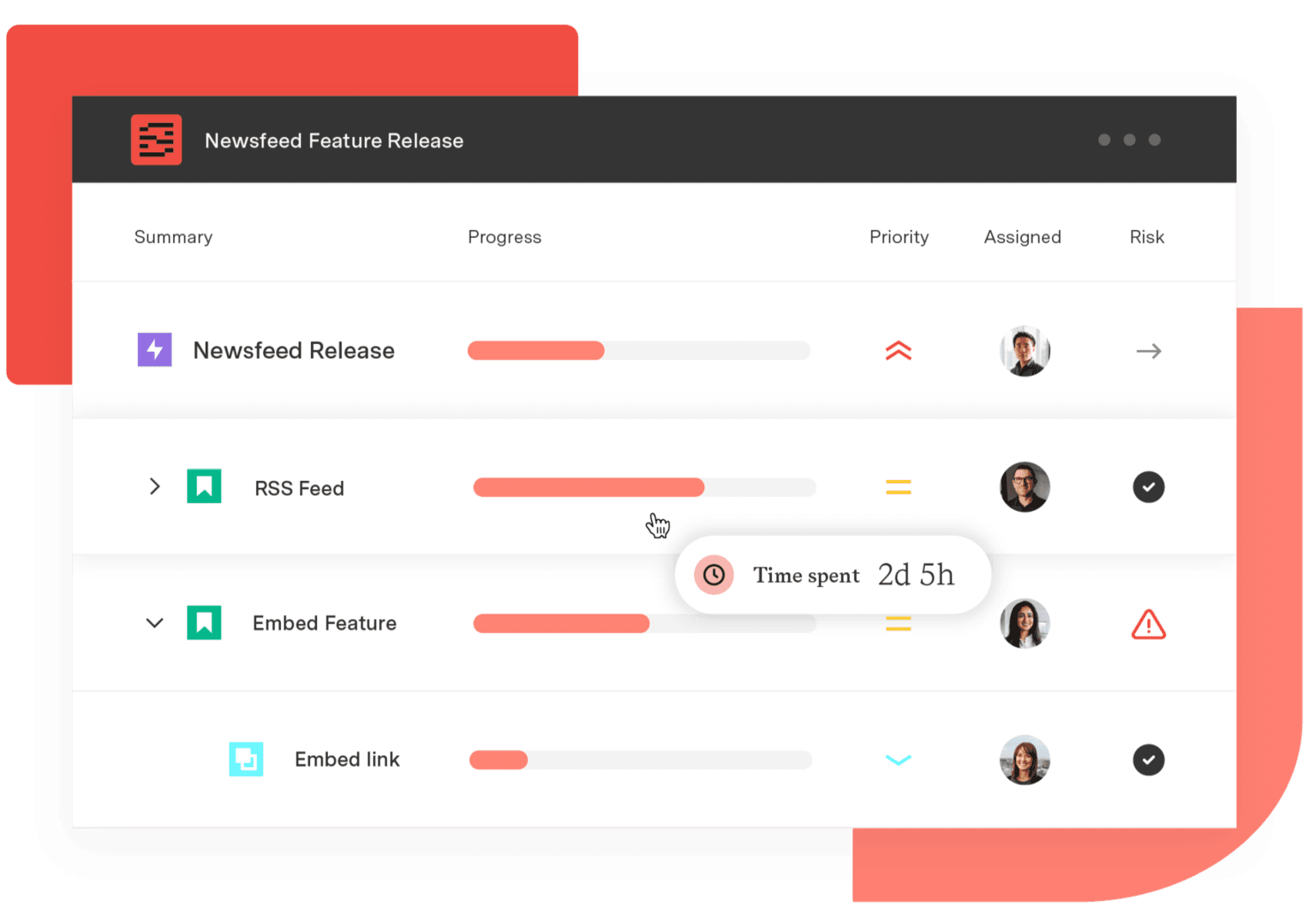
Structure PPM
Align your entire organization
Manage products, projects, and programs in a single spreadsheet-like view. By providing a clear, real-time view of project progress and resource allocation, Structure helps teams meet deadlines and adapt swiftly to changing priorities.
Start a Free TrialFrequently Asked Questions
Couldn't find what you need?Go to our documentation
Aha! offers strategy-driven budgeting and ROI modeling via custom worksheets in Aha! Roadmaps, scenario-based capacity planning at the team and individual level, and native developer timesheets in Aha! Develop. The architectural difference is where the data lives: Tempo Timesheets, Tempo Capacity Planner, and Tempo Financial Manager all extend Jira's data model directly, so labor cost accounting, capacity reporting, and time entries are tied to the Jira work items engineering teams already operate on – not maintained in a separate product strategy workspace.
Aha! offers a Jira integration, but it is a connector that syncs data between Aha! and Jira – not a Jira-native app. Tempo runs natively on the Atlassian Marketplace.
Both vendors publish current pricing on their own websites and quote enterprise deals based on user count and module mix. Compare current Tempo pricing at tempo.io and Aha! pricing on Aha!'s site rather than relying on any third-party number, which can go stale fast.
Tempo Financial Manager and Tempo Timesheets cover ledger-grade CapEx/OpEx accounts, labor cost tracking, and budget vs. actuals tied directly to Jira work items. Aha! covers strategy-driven budgeting and ROI modeling via custom worksheets – a different layer of the financial conversation.
Tempo Timesheets uses Atlassian Rovo agents – the Timesheets Worklog Assistant for natural-language time logging in Jira, the Timesheets Summary Analyzer for project and team-lead insights, and Time Insights for Jira for user-level time summaries – for AI-powered time logging suggestions, variance detection, and workload insights. Beyond Timesheets, Rovo agents span the suite: Structure View Builder turns a plain-language prompt into a portfolio view, Structure Formula Assistant writes rollup formulas, and Custom Charts Assistant builds Jira dashboard charts from natural-language prompts. Rovo is available across paid Atlassian Cloud plans, with full credit allocations on Premium and Enterprise.
Yes – for a while. Product teams keep Aha! for strategy artifacts while product leaders, PMO, finance, and engineering leadership use Tempo for portfolio governance and financial controls in Jira. Most enterprises eventually hit a budget conversation: if one tool can cover both strategy artifacts and execution governance, Tempo's modular path is what the CFO usually approves.
Tempo serves 30,000+ companies with 15+ years in the Atlassian ecosystem and is a three-time Atlassian Partner of the Year. Tempo Structure PPM scales to 30,000 issues per structure on Cloud and roughly 100,000 on Data Center, with support for multi-instance Jira and audit-ready governance. Compliance includes SOC 1, SOC 2 Type 2, ISO 27001/27701, and PCI DSS certifications, plus CSA STAR Level 1, DORA alignment, and a VPAT, with GDPR and CCPA covered via standard DPA. Rovo agents and these certifications apply to Tempo Cloud; Data Center has a separate compliance posture.