

Key Takeaways
Portfolio-level financial governance in Jira starts with clean, categorized data: accurate time tracking and CapEx versus OpEx classification that no dashboard can substitute for.
Real-time cost and utilization data only creates value when it triggers a reallocation decision while a project is still running – a status update after the fact arrives too late to change anything.
Audit-ready reporting means separating development and operational costs at the source and generating regulatory and executive reports from one governed data set instead of rebuilding them by hand.
A CFO’s audit committee never asks for a velocity chart. It asks for cost substantiation: which project spent what, on whom, and whether the spend created value. Jira instances rarely answer that question end to end, because Jira was built to track work, not to govern money.
Auditing project performance can feel impossible, whether you’re a project manager keeping a single budget on track or a CFO signing off on risk, profitability, and compliance across an entire portfolio.
This guide lays out how to track operational costs, utilization, and project performance across an entire portfolio – without leaving Jira.
Begin your workflow
Get started freeWhat Jira budget management means for a CFO, not a PM
Search for Jira budget management and you’ll find plenty of guidance aimed at the project manager’s desk: how to set up custom fields, how to multiply hours by hourly rates, how to run a basic Earned Value calculation. That content solves a real problem. It isn’t the CFO’s problem.
A CFO doesn’t need one project’s labor math. A CFO needs to know whether the whole portfolio is solvent, whether capital and operating spend are classified correctly for the auditors, and whether the numbers on the dashboard would survive a regulator’s follow-up question. That’s financial governance, not task budgeting. It demands a system built on top of Jira, one that treats cost data as a compliance artifact rather than assembling it after the fact.
That system has to do three things in sequence: govern the underlying data, turn it into action while a project is still running, and present it in a form an auditor or a board member can trust on sight.
How do you build audit-ready project data in Jira?
Every dashboard is only as honest as the data feeding it. Before a CFO can report on portfolio-wide cost with any confidence, the organization has to fix its Jira data hygiene: consistent time logging, consistent categorization, and an audit trail that holds up under scrutiny.
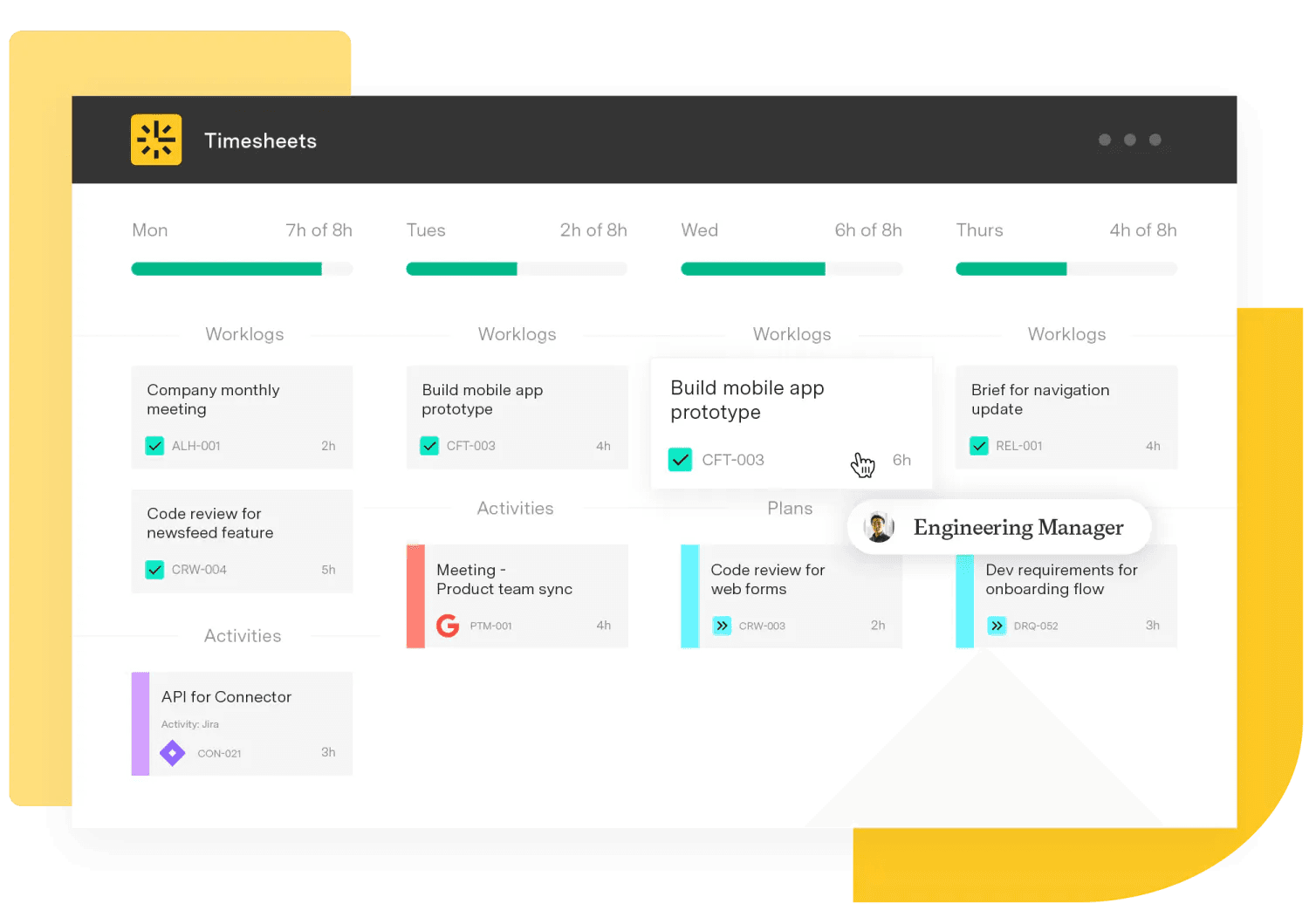
Tempo Timesheets fixes the first failure point. AI-enhanced automation captures time as work happens instead of relying on Friday-afternoon memory, and every entry lands in a time-stamped, exportable log with its own approval workflow – the kind of record an auditor can trace without a follow-up meeting. For a CFO, the payoff shows up in a different room: instead of an audit follow-up meeting where someone promises to go check the source data, the answer is already on the screen.
Classification is the second failure point. Time and expense need to split cleanly into billable versus non-billable, and separately into CapEx versus OpEx, so finance can capitalize development labor correctly and keep operational spend out of the wrong bucket. The stakes on that classification just went up: FASB’s ASU 2025-06, issued in September 2025, replaced the old stage-based capitalization test with a judgment-based one tied to the date management authorizes and commits funding to a project – which means the worklog evidence behind that authorization date matters more to an auditor, not less. Tempo Financial Manager applies CapEx/OpEx categorization at the project, epic, or portfolio level and tracks it against budget milestones and logged expenses, so finance can point to the underlying time data the moment an auditor asks how a number got classified.
Get this stage wrong and everything downstream inherits the error. A dashboard built on uncategorized time entries looks messy, and it hands the audit committee a number nobody can defend.
How do you turn utilization data into corrective action?
Clean data earns visibility. Visibility only pays off if someone acts on it before the quarter closes.
Once cost and time data are governed, Tempo Structure PPM and Tempo Capacity Planner turn that data into a live view of where teams and skill sets are focused. Dependency mapping and budget alerts and milestones surface risk before it becomes a variance line in a board deck, and filters let a CFO or a PMO drop from the portfolio level down to a single team without waiting on a custom report.
That visibility only pays off when it triggers a decision. Structure PPM and Capacity Planner let a CFO or PMO reallocate work and rebalance schedules directly in Jira, and because Financial Manager reads that same governed data, the cost of the reallocation shows up in the budget view without a separate export or a follow-up email to finance. A corrective action isn’t a plan for next sprint – it’s a change made and costed in the same sitting. Communicate the update to stakeholders in real time, and the quarterly status meeting stops being the moment people find out about a budget problem; it becomes the moment they confirm it’s already handled.
Every project eventually reaches one of two states: it needs another correction, or it’s done. If it needs correction, the same loop runs again with adjusted allocations and timelines. If it’s done, its actuals close out and roll into the portfolio’s financial history, informing the next round of forecasting instead of disappearing into a closed ticket. Most tactical budgeting guides stop at the single project and skip this part entirely: reallocate, measure, reallocate again, until the project delivers – or until it becomes one of the zombie projects a CFO can finally point to and defund, backed by worklog data instead of a hunch.
Stage 3: Turn dashboards into audit evidence
A dashboard that looks good in a demo and a dashboard that survives an audit are not the same artifact. The second one has to hold together under someone else’s scrutiny, on a day you didn’t choose.
Tempo Custom Charts for Jira builds executive and project-level dashboards segmented by role, so a CFO sees portfolio roll-ups and a project lead sees the detail underneath them, without either one having to export a spreadsheet to get there. A planned-versus-actual view, tracking budget, labor, total cost, and remaining spend side by side, turns a monthly reconciliation exercise into something a controller can glance at and sign off on. Development and operational costs stay separated at the chart level, so an auditor asking “show me the OpEx” gets an answer in seconds, straight off the chart.
For organizations that already run their financial reporting through Power BI, Tableau, or a similar platform, Tempo BI Connectors push that same Jira cost and time data through live pipelines, so the portfolio view inside Jira and the one in the CFO’s regular reporting stack never drift apart. Tailored reports for stakeholders and regulatory requirements come out of the same governed data set, generated once instead of rebuilt by hand for every audience.
A time-stamped worklog behind every capitalized cost, not a reconstructed estimate
CapEx/OpEx classification applied consistently across every project in the portfolio, not just the flagship ones
A documented authorization date for each capitalized project – the specific evidence ASU 2025-06 now expects
A planned-versus-actual cost view at both the project and the portfolio roll-up level
One reporting source that produces stakeholder and regulatory packages without a hand-rebuild for each audience
Why doesn’t manual reconciliation solve this already?
A reasonable finance team’s first objection is fair: “We already reconcile Jira data against the ledger every quarter, and it works.” It does work, for one project team, twice a year, when nothing goes wrong. It breaks down at portfolio scale, once the same reconciliation has to run across dozens of projects with inconsistent categorization, and it breaks down under audit timeline pressure, when an auditor asks for evidence from six months ago and the person who could explain that spreadsheet’s assumptions has already left the team. A manual reconciliation is a snapshot built after the fact – it can’t be reproduced on demand when the audit committee wants to see the same number a second time, and that’s exactly the moment audit prep turns into a war room instead of a data pull.
How the three stages work together
None of this requires ripping out Jira or asking engineering teams to adopt a second system. Timesheets governs the underlying time and cost data; Financial Manager turns it into budget and CapEx/OpEx views, while Structure PPM and Capacity Planner turn that same governed data into reallocation decisions while a project is still live. Custom Charts for Jira and BI Connectors then surface the result for whoever needs it, whether that’s a project lead checking burn rate or a CFO walking the audit committee through the portfolio. Each stage makes the next one more trustworthy, and a CFO who can trace a number back through all three has an answer ready before the audit committee finishes asking the question.
Stage | Tempo products | Outcome |
|---|---|---|
1. Govern the data | Timesheets, Financial Manager | Time and cost data is categorized and audit-traceable before it reaches a dashboard |
2. Act on it live | Structure PPM, Capacity Planner | Reallocation happens, and gets costed, while a project is still running |
3. Present the evidence | Custom Charts for Jira, BI Connectors | Role-segmented, audit-ready reporting generated once, not rebuilt per audience |
Timesheets
Optimize your projects, teams, and resources
The #1 time-tracking app for Jira. Timesheets seamlessly integrates with Jira and your existing workflows to help you track time for accounting, CapEx tracking, client billing, compliance, and more.
Start a Free TrialFrequently Asked Questions
Couldn't find what you need?Go to our documentation
No, and that’s true across every Jira Cloud subscription tier – Standard, Premium, and Enterprise all lack native budget, cost, or CapEx/OpEx fields. Without a dedicated financial governance app, most teams improvise: a handful of custom fields, a labor-rate lookup table, and a scripted export to a spreadsheet. That setup can track one project’s costs well enough, but it doesn’t scale to portfolio-level CapEx/OpEx reporting and rarely survives an audit request for data from six months back. Marketplace apps like Tempo Timesheets and Financial Manager solve this natively inside Jira, which matters because native budget fields aren’t on Atlassian’s public roadmap.
Cost and utilization data should update continuously so project teams can catch and correct variances immediately, but review cadence differs by audience. Project leads typically check burn rate weekly, finance or the PMO reviews portfolio roll-ups monthly, and the audit committee or external auditors expect a quarterly package built from the same governed data set, not a fresh reconciliation each time.
It works best as shared ownership rather than a single team’s job. Finance sets the classification rules, such as how CapEx and OpEx get defined and how billable time is treated, the PMO enforces those rules across projects and keeps Jira data hygiene consistent, and IT or the Jira admin team maintains the underlying configuration and access. None of the three can deliver audit-ready reporting alone.
It happens more often than most Jira budgeting guidance accounts for: a maintenance project scopes up into a capitalizable enhancement, or a capitalized initiative gets descoped back to OpEx-only support work. What an auditor cares about is whether the change is dated and evidenced, not backfilled after the fact. Because Tempo Accounts assigns CapEx/OpEx categorization at the worklog level, the recommended practice is to update the account going forward from the approval date and leave already-logged hours under their original classification – producing exactly the kind of authorization-date evidence FASB’s ASU 2025-06 now expects capitalization decisions to rest on.