

Most enterprise PMOs do not have a resource problem so much as a resource visibility problem. Capacity is split across portfolios, multi-teaming is the norm, and the spreadsheets used to plan it all are stale the moment they are sent. The result is predictable: late projects, burned-out specialists, and an executive team that cannot tell whether the next strategic initiative actually has the people to deliver it. Resource management and capacity planning, done at the portfolio level, is what closes that gap.
What is resource management and capacity planning?
Resource management is the discipline of matching the right people, with the right skills, to the right work, at the right time. Capacity planning is the forward-looking half of that discipline – modelling whether your teams can absorb new commitments without breaking existing ones.
At the portfolio level, both stop being a single-project exercise. You are no longer asking "does this team have room for this story?" You are asking which initiatives the enterprise can realistically deliver this quarter, where the dependencies are, and which roles you need to hire, contract, or reallocate to make the strategy land.
That requires three things: a single source of truth for what work exists, a model of who can do it, and the ability to compare planned effort against actuals so the next plan is sharper than the last.
Why resource management and capacity planning matter at the portfolio level
When capacity is invisible, leadership commits to portfolios the organization cannot deliver. Gartner reports that only 16% of organizations are effective at resource and capacity planning, and that, by 2025, 70% of digital investments will fail to deliver their expected outcomes without a strategic portfolio management approach. The connecting thread is resourcing: strategy without capacity is a wish list.
The business stakes are concrete. Misallocated specialists drag program timelines and inflate costs. Multi-teaming, where the same engineers are committed to three or four initiatives at once, masks itself as productivity until a dependency slips and exposes the truth. Hiring decisions made without portfolio-level capacity data lead either to overstaffing or to the kind of last-minute scramble that erodes margin and morale.
For PMO directors, CIOs, and finance partners, portfolio-level resource management is a governance function. It is how you defend the plan to the board, how you decide which initiatives get funded next quarter, and how you protect delivery confidence when priorities shift mid-cycle.
Benefits of resource management and capacity planning with Tempo
Portfolio-wide capacity in one view. See workloads, skills, and availability across teams and initiatives without exporting Jira data into a spreadsheet.
Skills-based allocation. Match work to the right specialists by tagging team members with skills and assigning them where their expertise has the highest return.
Plan vs. actual learning loop. Compare planned capacity to logged time and use the variance to sharpen the next forecast.
Earlier hiring signals. Spot capacity gaps far enough in advance to hire, reskill, or rebalance before a deadline is at stake.
Multi-teaming visibility. Surface employees who are committed across too many initiatives and rebalance before burnout becomes attrition.
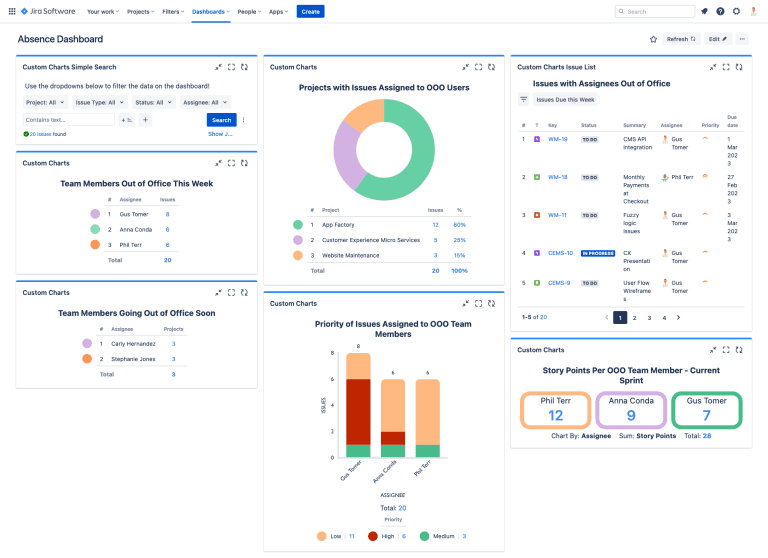
How Tempo enables resource management and capacity planning
Tempo's approach pairs Capacity Planner with Structure PPM so that capacity is modelled in the same place portfolios are governed. Capacity Planner gives resource managers and team leads the ability to view and balance workloads across multiple individuals and teams, schedule the same employee across more than one initiative, and tag people with skills so allocation decisions reflect real expertise rather than headcount.
Structure PPM provides the portfolio scaffolding. Custom hierarchies aggregate work from across Jira projects into the views a PMO actually uses – by program, by portfolio, by strategic theme – so capacity questions are asked in business language rather than Jira filter syntax. When capacity data flows through Structure, executives can see which strategic initiatives are realistically resourced and which are at risk.
The forecasting loop closes when Timesheets is in the mix. Capacity Planner integrates with Timesheets to compare planned time against actual time logged, turning every quarter into a learning event. Forecasts get more accurate. Estimates get more credible. The PMO stops apologizing for plans that drift from reality.
For executive reporting, Custom Charts for Jira visualizes capacity, utilization, and plan-vs-actual data on Jira dashboards and Confluence pages – without the IT ticket cycle that usually surrounds enterprise BI. Together, these products form Tempo's Program Collection, the bundle Tempo recommends for organizations that need governance and resource clarity at program and portfolio scale.
Sign up for a demo
Request Demo