It’s not just for IT. Learn how Jira benefits teams across your entire organization, thanks to its customization, flexibility, scalability, and more.
The history of Atlassian is a gripping tale. Discover its highs and lows, from bootstrapped start-up to industry darling worth over $50 billion.

A lot has changed for Atlassian since founders Mike Cannon-Brookes and Scott Farquhar decided to max out the $10,000 limit on their credit card to launch what would become the world’s leading agile project management software, complete with a suite of integrated tools.
How did two university grads from New South Wales, Australia, go from solving problems for support teams to building a $50 billion business? Let’s look at the history of Atlassian to learn where the company has come from, where it’s at, and what’s in store.
The year 2022 was an eventful one for Atlassian. Not only did it mark 20 years since co-CEOs Cannon-Brooks and Farquhar decided to chuck the suits and ties of the corporate world to build computer software with their mates, but it’s also the tenth anniversary of Atlassian Marketplace.
Marketplace is one of many novel ideas that have bolstered the company’s growth since its inception. And it won’t be its last. To predict what’s in store, we must revisit Atlassian’s evolution, starting in 2002.
Mike Cannon-Brookes and Scott Farquhar were toiling away, offering support to other companies’ customer service teams. Bugzilla, the software they used to track their work, couldn’t meet their needs, leaving them answering client phone calls at all hours.
Finally, they bootstrapped their own issue tracking and project management software, naming it Jira, a play on Gojira, the Japanese title of the 1954 film Godzilla. They soon realized they were better off selling Jira to the masses than providing support services.
Atlassian was born.
Mike and Scott recognized the US as their biggest target market, meaning they had to either invest in a traditional sales team or build a self-service purchase platform. They opted for the latter despite the risk.
The co-founders knew it was the right decision when they awoke one morning to find a purchase order from American Airlines sitting in their fax machine. Neither one had made a sales pitch.
With the launch of Confluence, Atlassian’s collaboration software, the company’s momentum was building. Most clients were in the United States, prompting them to establish a presence in North America. Atlassian opened a small New York office but quickly realized they had overextended themselves. The office soon shut its doors – a difficult but necessary step to establish a habit of making tough calls.
Recognizing that Atlassians needed time and space to innovate, the company established ShipIt, a quarterly hackathon allowing employees 24 hours to create, test, fail, and try again on any project they like with whomever they please.
ShipIt was a hit, becoming a tradition that generates new product features and internal programs. The most notable development was Jira Service Management (JSM), Atlassian’s fastest-growing product to date.
Being firm believers in giving back, Mike and Scott established the Atlassian Foundation, pledging to donate 1% of company profits, products, equity, and employee hours to service organizations. By adopting the commitment early on and integrating it into the operating model, Atlassian has made community support a normal part of everyday business.
Since 2006, the Atlassian Foundation has donated more than $54 million and 200,000 volunteer hours, supplying more than 133,000 nonprofits with free or deeply discounted product licenses.
Atlassian’s co-CEOs believed company values shouldn’t be aspirational but reflective of the best parts of the organization as it exists. When they set out to codify the company’s values. Mike and Scott collaborated with Atlassians to answer the question, “What aspects of Atlassian do we want to endure?”
Here’s their answer:

(Source: Atlassian)
Jira’s first user group launched in 2006 when a Reston, Virginia, software admin took it upon herself to meet with other nearby Atlassians. By 2008, the company supported these grass-roots get-togethers with pizza, beer, and T-shirts. Fast forward to the present day, and Atlassian community events host 24,000 users annually thanks to a dedicated internal team.
To round out the aughts, the software company decided to host the first Atlassian Summit in San Francisco. Mike, Scott, Atlassian team members, and about 340 customers came together for a round-table style conference to answer questions and receive feedback.
The conference was somewhat awkward and unpolished, but it sparked a turning point for the company, changing how Atlassian builds empathy and relationships with its customers.
Mike and Scott decided it was time to level up business growth and began searching for investors with the right fit. They found Accel Partners, a venture capital firm that shared Atlassian’s values and perspective on company leadership. The firm didn’t ask the founders to change their business model or culture, thus forging a profitable partnership.
Their association led to the purchase of Bitbucket in September 2010. Since then, Atlassian has made more acquisitions, including Chartio, Loom, and OpsGenie.
Atlassian faced another tough call. The company decided to remove the wiki markup language from Confluence in favor of plain text editing. They knew the switch would be painful for their clients, so they took steps to make the impact quick, minimal, and beneficial long-term.
Jira’s 10th anniversary was a year of highs and lows.
The Atlassian corporation was feeling the typical growing pains of a high-growth company. The business experienced high turnover rates as employees re-evaluated their place in the company. Some decided a large organization wasn’t for them; others realized they were no longer a good fit. It was challenging, but with compassion and transparency from leadership, employees could face the transition feeling valued and appreciated.
Despite this adjustment period, the launch of Atlassian Marketplace buoyed the company’s prospects. The idea sprung from a desire to customize the Jira software to provide additional functionality.
Mike and Scott wanted to ensure customers remained loyal. In a nod to the company’s core value of “be the change you seek,” they released Jira and Confluence’s source code to users so they could modify and customize their instances.
The release of the API allowed Atlassian to partner with 1,250 enterprise developers and solution partners, building a catalog of 5,700 apps. These applications extend Jira and Confluence functionality, driving long-term brand loyalty and, as of 2021, a cumulative sales revenue of $500 million.
New experiences spark innovation, an essential aspect of Atlassian’s success. The software company began a foreign exchange program, placing volunteers in other teams and offices worldwide. These secondments have been incredibly successful, building fruitful relationships between employees.
This year, Atlassian was honored with the top spot on the Great Places To Work in Australia list for companies with more than 100 employees. The award reinforced the company’s commitment to hiring great people and providing them with the resources and freedom to do their best work. By treating employees well, the company has built a fantastic staff and corporate culture that attracts the best and brightest Australians and the tech industry’s top candidates worldwide.
Sure, 2015’s IPO on NASDAQ was a significant step forward in Atlassian’s development. But everyone remembers the company’s formal adoption of its mission statement.
“Atlassian exists to unleash the potential in every team.”
The statement defines who Atlassian aims to be to all its stakeholders, providing an internal focus and helping secure external buy-in.
Diversity in the tech industry was a hot-button topic in 2016. Atlassian decided to confront its shortcomings head-on by releasing its first-ever diversity report. By sharing the results publicly, the company lived up to its “open company, no bullshit” value, held itself accountable, and encouraged other organizations to do the same.
Atlassian remains committed to improving employee diversity and continues to share its progress via its annual sustainability report.
Over the years, Atlassian has acquired several companies as part of its expansion strategy. The goal was to secure brand loyalty by augmenting its product offerings to support teams outside the dev department.
In 2017, they made their boldest acquisition, a $425 million deal for Trello, the breakout star of the fast-growing collaboration software market. Trello is an excellent complement to Jira and Confluence, and its mission, values, and culture are closely aligned with Atlassian, making it a perfect fit.
Back in 2012, Atlassian purchased a group chat platform called HipChat. The company didn’t immediately dive into the chat room market, only pivoting to launch a new version called Stride in 2017. By 2018, Slack had taken the world by storm, forcing Atlassian to make the painful decision to shutter Stride later that year. Thankfully, the leadership team moved quickly and found new roles for every member of the Stride team.
2019 was the year of the cloud for Atlassian. Leadership announced they were mothballing Atlassian Server to switch operations to the Cloud platform, terminating licenses by 2020. 98% of all new customers with Atlassian in Q2 of 2022 opted for Atlassian Cloud.
The company also looked beyond its walls to recognize the threat of climate change. Atlassian joined the Global Climate Strike, began reducing its eco-footprint, and advocated for sustainability. The business is committed to becoming a net-zero emissions business by 2040.
Like many others, Atlassian shuttered its global offices in March 2020. Leadership predicted the remote work model would continue after COVID-19, leading the company to permanently shift its workforce to a work-from-home or hybrid arrangement. This flexible operations model freed Atlassian to recruit from thousands of cities beyond the 13 communities with in-person offices.
Global unrest took its toll on Atlassian staff in 2021. Many employees were suffering from anxiety and burnout. Leadership again took action, expanding internal programs to help avert a widespread mental health crisis. The company invited experts to speak with employees, offered them access to meditation apps, and encouraged Atlassians to take time off for rest and recuperation.
With the transition to cloud technology complete, Atlassian sought ways to make its service more reliable. 2019 saw the release of Tenant Context Service (TCS), an essential part of the service infrastructure facilitating client web requests from the company’s cloud-based servers. Since the launch of TCS, the development team has improved the platform’s robustness, implementing client co-processes called sidecars and evolving the system into a high-performing and resilient node-local cache.
As a result, sidecars deliver 32 billion requests daily and run concurrently across 10,800 nodes, with a cache hit ratio exceeding 99.5% for their most reliable availability yet.
2023 was a rollercoaster ride for Atlassian. Despite hackers’ attempts to exploit Confluence vulnerabilities, the company reported expected revenue between $950 million and $970 million, suggesting 19% growth for the year. Leadership also announced that margins would expand, fueling a 32% jump in share value.
Atlassian continues to add winning software like Portfolio Manager to its stable of project management tools for managing tasks, workloads, and more.
Atlassian aims to leverage artificial intelligence to accelerate work and drive action for project management teams. The beta phase of Atlassian Intelligence launched in mid-December 2023, with many features now available across Atlassian Cloud products, including Jira Software and Confluence.
Tempo is proud of its association with tech giant Atlassian. Our partnership has resulted in a suite of Jira-enabled applications to build upon the company’s project management software. All Tempo’s applications are available through the Atlassian Marketplace, from Strategic Roadmaps, our project roadmapping software, to Timesheets, a time and resource management application, and Custom Charts, a Jira data visualization tool.
Tempo was the proud winner of Atlassian's type: entry-hyperlink id: 2A00PoBBjFLORJDPcRQGX.
No matter what your Jira software needs, Tempo has an app that can help.
Sign up for a demo
Request Demo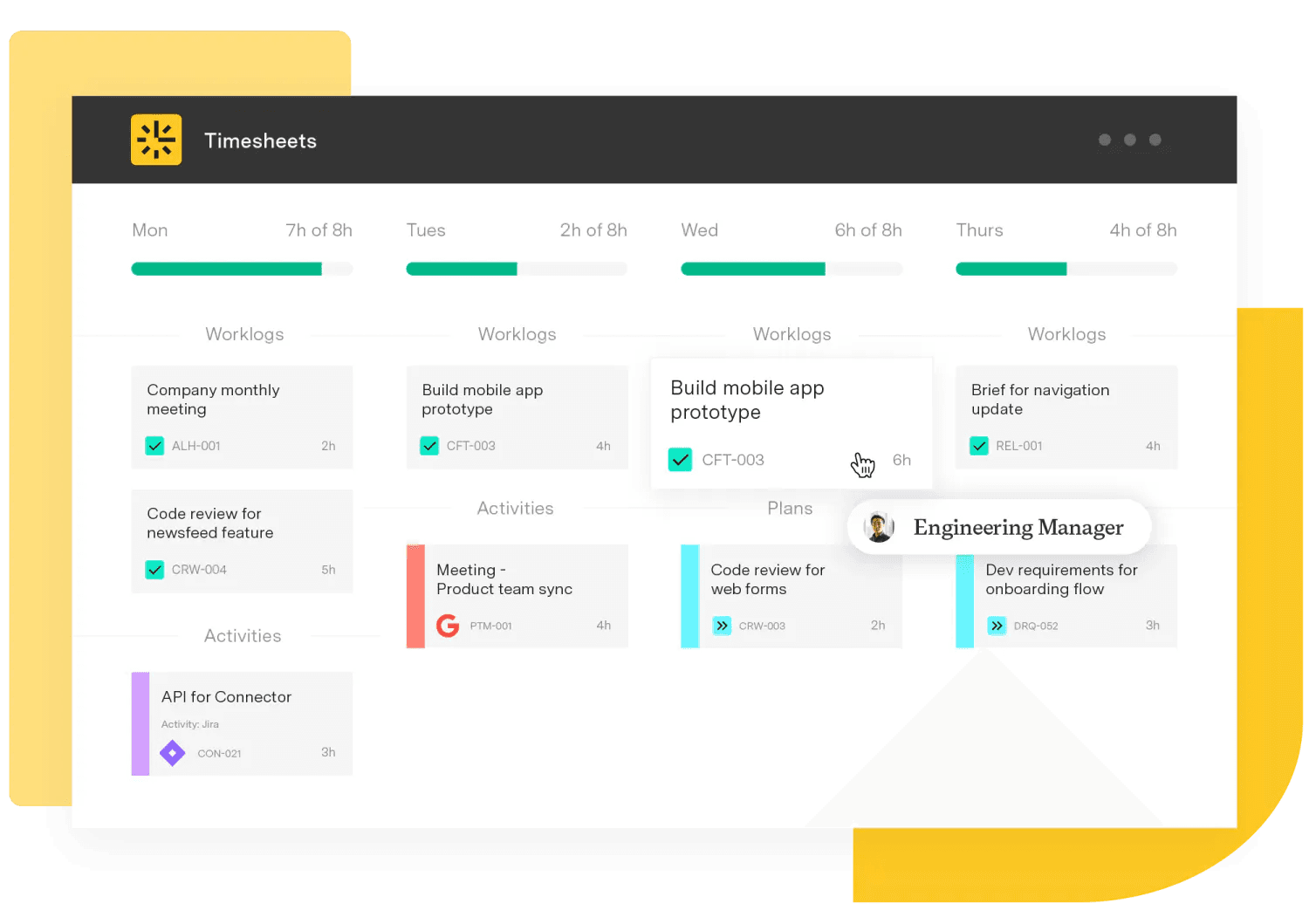
Timesheets
The #1 time-tracking app for Jira. Timesheets seamlessly integrates with Jira and your existing workflows to help you track time for accounting, CapEx tracking, client billing, compliance, and more.
Start a Free TrialIt’s not just for IT. Learn how Jira benefits teams across your entire organization, thanks to its customization, flexibility, scalability, and more.

Here’s what’s going on, and what it means for you that Atlassian is ending Data Center support by March 2029

Leverage Atlassian Confluence to build effective project teams by providing a workspace that facilitates information sharing and collaboration.

Spotify’s agile model propelled the company to become the world’s most popular music streaming service. But should other companies follow its example?

Part 1 of a 2-part Atlassian guide for beginners by beginners, offering first impressions of Jira and Confluence from our own newbies.

Have a role to fill but not sure where to start? Learn how to hire employees – from recruitment to onboarding – find the perfect person for the job.

Migrate to Jira Cloud with confidence. The software’s new features are exciting, and Atlassian provides resources to support a smooth transition.

Announcing 12 awards in multiple categories to reflect on the contributions our partners have made and celebrate what we have achieved together.

An AI governance framework covers model risk: Here is how to also govern the work your autonomous agents do, from capacity to cost to outcome.